Showing posts with label Themes. Show all posts

Wednesday, December 28, 2011

Mirror, Mirror on the Series

In life, mirrors reflect reality rather sharply and, to some POVs, unforgivingly.  In fiction, especially fantasy, mirrors may take on a magical quality and provide insight into the subjects they reflect, or show people and action beyond its borders, such as the mirror in Snow White.  However reflections also serve as a literary device.  By mirroring a later action or scene against an earlier one, the author can, through differentiation, show character growth, deepening conflict, or earned triumph.

J.K. Rowling works frequently with mirrors both as a thematic image as well as scenic reflections. From the emulation of a heart's true desire in the Mirror of Erised at the beginning of her saga, to the providential eye of Aberforth Dumbledore watching over the Trio through the broken mirror, mirrored scenes provide the reader greater understanding through deepening perceptions and contrasts.

Perhaps one of the most striking mirrored devices is the framing of the series itself.  Have you ever noticed that the last half of the series reflects the first with Goblet of Fire as the pivot-hinge? When you look at the series from this vantage point, Order of the Phoenix reflects Prisoner of Azkaban, Half-Blood Prince reflects Chamber of Secrets, and Deathly Hallows reflects Philosopher's/Sorcerer's Stone.

In Prisoner of Azkaban, Sirius Black is introduced as a murderous escaped prisoner intent on harming Harry and almost loses his soul. In Order of the Phoenix, Sirius is the loving godfather, imprisoned in his own home, who saves Harry and loses his life.

In Chamber of Secrets, the mysterious Tom Riddle is introduced. Through Riddle's diary, Harry explores his past at Hogwarts -- but through a web of lies as Voldemort's soul presents it. A monster is set lose in the castle, and innocent students are petrified. In Half Blood Prince, Harry and Dumbledore together explore Voldemort's past through the truthful reflections of the Pensieve (itself a mirror-like object). In the end, the monstrous Death Eaters are set lose inside Hogwarts, and Dumbledore is killed defending his students.

Wednesday, December 21, 2011

A Harry Potter Christmas

As I'm running around getting ready for Christmas in North Carolina, I can't help but think about the wonderful, snow-covered Christmases Harry spent at Hogwarts or with Sirius and the Weasley family.  With each book, J.K. Rowling seemed to delight in crafting something special for two specific holidays.  With Halloween usually came something appropriately spooky -- like trolls in the dungeon, or a Death-Day Party.  But with Christmas came a Great Hall full of decorated trees, presents from Harry's new and expanding "family," and often new clues for the developing mystery.

Here's some of my favorite tidbits from each of the Harry Potter Christmases.

Philosopher's/Sorcerer's Stone:
Seeing the Great Hall decorated for the first time with 12 magical Christmas trees ranks right up there with Harry having his best Christmas (away from the Dursleys!) ever.

For his first real Christmas, Harry gets:

  • a roughly cut wooden flute from Hagrid that sounds a bit like an owl
  • fifty pence from the Dursleys
  • an emerald sweater and box of fudge from Mrs. Weasley
  • a box of Chocolate Frogs from Hermione
  • and the invisibility cloak from Dumbledore

With the gift of the first sweater (jumper in the UK), Harry becomes an adopted member into the Weasley clan.  And as George says when telling Percy he has to sit with them at the feast rather than the Prefects, "Christmas is a time for family."

Three of these gifts are necessary tools to help Harry figure out the mystery surrounding Nicholas Flamel and the Philosopher's Stone.  The invisibility cloak helps Harry sneak around Hogwarts.  Flamel is revealed to the Trio through his Chocolate Frog card, and Hagrid's flute helps them get past Fluffy.

Monday, July 25, 2011

Mad-Eye's Magical Eye

Because I've got a new toy I want to play with today (CommentLuv!), and because I don't yet have my blog post ready, I'm re-posting one of my favorite posts (with updates!!) from the early days of this blog. However, I see from the poll over to the right, that not as many of you are as in love with the Egyptian mythological references in Harry Potter as I am!!  That's ok, you can suffer through today. :-)

Actually, you may want to comment anyway because my new toy is supposed to show/link to your last blog post on YOUR blog when you comment on mine.  I want to make sure this new widget works properly before I put a new post up.

So...play along. Please....Thanks!

**^**

Look at the three images I have on this post and see if you recognize any similarities.

Let's start with the first image, the ancient Egyptian Eye of Horus.

The Eye of Horus was an amulet of healing and resurrection. One of the most revered and powerful amulets in ancient Egypt, the Eye provided protection from evil. It was a symbol of royal strength and assisted in the rebirth of the deceased.

As the granddaddy of apotropaic amulets, meaning a talisman that turns back harm or evil, the Eye was so popular that it spread throughout the region and the centuries, morphing and adapting to various cultures, but always retaining the staring single eye. It is truly very old magic.

nazar boncugu

The Eye still exists in various incarnations even today. It is very popular throughout the Middle East, especially in Turkey where it is known as nazar boncugu. In Turkey you will still see this amulet nailed over doors to homes, decorating the hulls of ships, and pinned to the clothing of young children, placed there protectively by their loving mothers. (Actually, you see it EVERYWHERE! :-)


Now let's look at Mad-Eye's mad and magical eye.


From Goblet of Fire:
But it was the man's eyes that made him frightening.


One of them was small, dark, and beady.  The other was large, round as a coin, and a vivid, electric blue.  The blue eye was moving ceaselessly, without blinking, and was rolling up, down, and from side to side, quite independently of the normal eye -- and then it rolled right over, pointing into the back of the man's head, so that all they could see was whiteness.  (p. 184-185)

Hmm. An all-seeing round eye with the colors of black, blue, and white... Ya think there's a connection?

A few years ago, when E.L. Fossa of Wizarding World Press pointed out to me the similarities between JKR's creation and the Turkish nazar boncugu, I felt a bit dimwitted.  Here I was, married to a Turk, having lived in Turkey many years, with many boncuks hanging in my house, on my keychain, or pinned to my children's clothes when they were babies, and I'd not made that connection.  Yet, this was the early days of my induction into the murky subtext of Harry Potter and I was only then learning how to seek below the surface.


If I'd had any remaining doubts that JKR intended for the reader to make these connections to the nazar boncugu or the Eye of Horus, it was  was when she had Umbridge nail Mad-Eye's glass eye to her office door just like the Turks do with their good luck bead that cinched it for me.  On the surface, Umbridge's action was just a bit odd.  And you can bet, whenever JKR is doing something that seems odd or slightly out of place, that she's getting at a deeper meaning, most likely using a mythological reference.

But ... why would JKR pin a benevolent amulet onto a character who in his first appearance is a Death Eater and fraud?  I think there's an initial reason, and then a deeper one that leads to the underlying mystery of the series.

First the initial reason -- the Eye of Horus, as well as its descendant, the nazar boncugu, are amulets that represent the protection of an all-seeing divinity.  In Goblet of Fire, pseudo Mad-Eye (aka Barty Crouch, Jr.) fills this role.  He sees all, knows much more than any other character what is truly going on, and is bent on protecting Harry and getting him through as champion in the Tri-Wizard Tournament.  Unfortunately, all this protection is aimed at sacrificing Harry to his lord and master, Voldemort.

However, in the end, despite himself, Crouch's protection works effectively.  It is Barty Crouch as Mad-Eye who taught Harry how to throw off the Imperius curse, an ability that helps Harry survive his encounter with the Dark Lord and return safely to Hogwarts.

 For a deeper analysis of these ancient references -- JK Rowling utilized ancient myths, I believe, to show the continuity of belief....Jung's universal collective subconscious, if you will.  What people have believed for two thousand years, still rings true today...as long as you change the clothes and settings.  Good versus Evil, the eternal nature of Love, our need to fight our Shadow and triumph.  All this rang as true to Egyptian ears three thousand years ago as it does to ours today.

As writers, we have the option of working sub-textual meaning into our stories.  If we do so with skill and resonance, as JKR has done with Moody's eye, then we've provided a whole new layer for the reader to engage within our pages, time and time again.

Notice that JKR never says the words Horus or Egyptian mythology in the text.  Nor does she point out directly the resemblance of Mad-Eye's bulging blue eye to the Turkish good luck charm.  She simply describes her creation in a similar way, has it utilized in a related manner, points the reader in the direction of Turkey and Egypt in other places (Bill's work in Egypt, the Egyptian Quidditch referee, and the mention of Ludo Bagman's win over the Turkish Quidditch team).  Thus, with such subtle but deliberate hints, the game master leaves these little Easter Egg delights for the reader to discover.

That's the joy of subtext and why layers of it added to your writing bring your reader back to your story time and time again.  Readers delight in being able to read a Potter novel for the second, third, (cough, sixth, cough) time and still discover meaning that was not evident on an earlier read.

So, why would JKR draw so much attention to this particular ancient Eygptian amulet?  I have a theory and it points to the Horcruxes.  But that's a huge 'nother post. (Actually, it became two. You can read When is a Horcrux not a Horcrux here, and That Deathly Hallows Symbol here.


Have you layered in subtext in your writing? What technique have you found to be the most useful for referring to a theme, myth, or item below the surface?


Photo credits:
Eye of Horus
Nazar Boncugu
Mad-Eye Moody 
Door with Boncuk, Turkey

Friday, July 22, 2011

Circling Home to Theme


“Well then, I think the answer is that a circle has no beginning.”
---   Luna Lovegood, Deathly Hallows

One of JK Rowling's thematic images that I believe to have been most powerfully conveyed in the movie Prisoner of Azkaban was that of the spiral. Remember Trelawney's crystal globe thumping down the spiral staircase of the Astronomy Tower? Or what about the spiral of the fossilized snail on the rock that Hermione threw at Harry's head in the time-turner sequence?

Alfonso Cuaron's film was one of the most artistic of the series, and he knew how to hit home (and heads!) with certain themes. The spiral is a beautiful metaphor for how Jo dealt with themes throughout the Potter series

How JKR begins her story is how she ends it, but not in a simple circle where nothing is gained or loss, but as a spiral, ever progressing.

I'd like to look at five of the main themes that JKR developed throughout the series which carried through to the climax of the final chapter. We'll examine how she introduced each theme, how they spiraled through the story, and what she finally had to say about each one at the conclusion.

Loyalty:

"It was here," [Ron] touched a point close to his heart, "I could feel it, it was hot. And once it was inside me I knew what I was supposed to do, I knew it would take me where I needed to go."
----  Ron Weasley, Deathly Hallows

It could be argued that the action which sets this whole Potter saga in motion is when Peter Pettigrew betrays his best friend James. His act of disloyalty in order to save his own rat hide leads the whole wizarding world into a downward spiral of darkness and war, with deaths suffered by the many touched from the Death Eater's and Voldemort's wands.

(article continues below)


One of the aspects of the series fans will often mention as their favorite is the loyalty shared between the trio of friends Harry, Ron, and Hermione. And yet, each has a fall-out with the others through the course of the seven books. Ron's jealousy with Harry causes them not to talk for weeks during Goblet of Fire. Harry won't forgive Hermione for reporting his Firebolt to McGonagall in Prisoner of Azkaban. And of course, Ron's fight with Hermione over Crookshanks killing Scabbers not only pointed to a major theme, but a crucial plot device as well.

But perhaps the greatest show of tested loyalty came in Deathly Hallows when, suffering form the effects of wearing Voldy's Horcrux, Ron left his best friends. It was his love and loyalty for them, as well as Dumbledore prescience in gifting Ron the Deluminator, which enabled his return. For what is a Deluminator exactly? For JK Rowling, a Deluminator takes light from one source and sheds it upon what is most important to that person. For Ron, his love of Hermione, and his loyalty to his friends, is the guiding light that brings him back into the heart of the trio.

While Bellatrix shows extreme loyalty to Voldemort, hers is an example of a perverted twist of loyalty that is not returned and only results in the harm of others. Voldemort is loyal to none as he AK's or tortures anyone who trips him up, no matter how loyal they have been in the past.

Finally, it is the loyalty of the three friends, the loyalty of the students toward Hogwarts, including Slytherin, and the loyalty of Snape to his childhood love, that conquers the lonely Voldemort and his band of demented souls whose only true loyalty is to themselves and their own desire for eternal power.

Even though as hero, Harry must in each ending take the final step, he never would have made it to the point of facing his worst fears without his friends by his side. As Sirius says, keep your friends close. Because what is life without friends?


Death:


"To the well-organized mind, death is but the next great adventure."
------  Dumbledore in Philosopher's/Sorcerer's Stone

According to Dumbeldore, as the mouthpiece for JK Rowling, sometimes the things we most want as humans are the last things that will truly make us happy. Voldemort pursues eternal life with a rapier-sharp passion unrivaled by other wizards. And yet, is Voldemort ever truly happy?

Death looms over the series from the beginning through to the end. From the deaths of Harry's parents, which brings him into the home, if not the bosom, of the Dursley family, to the deaths of Cedric, Sirius, Albus, Remus and Tonks, Fred, Collin, and many others, the fear and often untimely ending of everything human is explored from various perspectives.

The taking of life is the most evil spell a wizard can cast, which leaves a permanent blight upon his own soul. Whereas the acceptance of one's own death is perhaps presented as the noblest, even if the most shocking -- Dumbledore's fore-planned sacrifice. (For the rest of us Muggles, it's called a Living Will).


A Rainbow of Gray:

"The world isn't divided into Good People and Death Eaters."
------ Sirius Black in Order of the Phoenix

People are not divided into black and white, but most of us exist in some shade of beautiful gray.

While the series started off somewhat simplistically, with Harry's world fairly well defined between the good and the bad, it did not remain that way. Over the years, Harry not only had to face the mistakes and disappointments made by the adults and friends around him, but had to also come to grips with the dark side of his own character.

For me, the most exemplary moment in which Harry explored the darkness of his own soul was when he cast the sectumsempra spell at Malfoy. In every place before, even when confronting Death Eaters and Voldemort, Harry aimed to disarm, petrify, or impede, not to physically harm. From this point with Draco, Harry understood the fire he'd been playing with in the Half-Blood Prince's potion book and gets rid of it. How fitting it is, then that in the end of DH, Harry saves Malfoy's life (twice)!

This theme of the various shades of gray of human character is best exemplified by Snape, who is one of the grayest. (For more, please see my post on Snape's Gray Undies). Indeed, it is because of Snape's very gray, ambiguous character that he is also considered the most intriguing in the whole Potter universe.

Even Voldemort, the chief baddie and darkest character in the book, is shown with a touch of gray when through the Pensieve we see what brought him as a child to such darkness.

In the end, Harry does not defeat Voldemort as the white knight on a stallion charging at a black dragon, but rather as as a young man who has faced his dark side, challenged his shadow, been refined and strengthened through conflict, and learned to trust the loving side of his nature rather than his hatred and fear of death. Because, for JK Rowling, the key ingredient in determining what shade of gray we reflect relies on what choices we make.

Choice:

"It is our choices that show what we truly are, far more than our abilities."
------  Dumbledore, Philosopher's/Sorcerer's Stone


From Harry's first moment of choosing Gryffindor over Slytherin, and Dumbledore's explanation, we know that this is one of the main themes of the series. Harry chooses to risk winning the TriWizard tournament in order to ensure that Fleur's sister is safe. He chooses to claim the Goblet of Fire with Cedric. He then chooses to risk his life to bring Cedric's body back to his parents. Ron and Hermione choose to accompany Harry on his dangerous quest to find and eliminate Voldemort's Horcurx. Ron chooses to return. The examples are too numerous to name. We see choices that bind friends together as when Hermione covers for Ron and Harry about the troll, and choices that tear families apart, as when Percy turns his back on his family. Finally there are the choices that kill, such as making Horcruxes, and choices that save, such as finding Hallows.

In the end, Harry makes the choice to disarm Voldemort rather than to kill. It is Voldemort's choice to kill anyone standing between him and eternal life which denies him that impossible dream.

Love:

Dumbledore: "She sacrificed herself for you. And that kind of act leaves a mark... This kind of mark cannot be seen. It lives in your very skin."
Harry: "What is it?"
Dumbledore: "Love, Harry. Love."
------ Philosopher's/Sorcerer's Stone

Finally, the inner core that guides the choices a person makes is the love that person feels. Love is the most powerful, ancient magical theme in JKR's awe-inspiring arsenal. It is love that makes Lily give her life freely in order to save her baby's. It is love that lives in Harry's skin protecting him from Quirrel's touch and Voldemort's reach in his mother's blood house. It is the love that Harry feels for Sirius that Voldemort cannot stand to come in contact with. And it is love of his friends and adopted family and sharing in those they have lost that guides Harry's feet into the Dark Forest to lay down his own life so that others may live.

To be denied love is to not only never truly live, but to also exist in the meanest way possible. To be denied the love you seek, even when it may be your own fault, is to live a bitter life, never filled with the joy of sharing your innermost dreams with another.

Love is the magic that lives beyond the grave. Love is the balm that carries us through a Dementor's attack. And love is the music of the Phoenix song that lift our hearts and inspires us in our darkest times.

What themes do you work with in your own novel? How have you introduced it to your reader? Have you shown the theme in its full glory, from its negative through to its positive aspects? Have you brought your theme home, in a magnificent spiral from the beginning, to conclude it at its strongest, most powerful impact?  And can you somewhere, somehow in your story encapsulate your theme in the words of one of your characters?

Themes help guide our writing, keeping us on track as authors. For myself, I may be able to start a story without a theme in mind, but I won't be able to conquer the hard parts until my core is identified. I think of theme as the hub of my story's wheel, around which rotate the spokes of character, plot, setting, conflict, and metaphor. Any time I get stumped, and am unsure of which choice to take, I go back to my theme and let it guide me.

How you choose your theme is as varied as there are writers out there. But one thing is for certain. Choose your theme wisely, for if it does not resonate with you personally, it does not stand a chance in an Inferi cave of igniting a flame within your reader's heart.


(Check Out JK Rowling's Newest Release -- Harry Potter and the Cursed Child here!) 

Monday, July 4, 2011

Drawing the Final Curtain on an Epic Story

Chapter Thirty-Six, The Flaw in the Plan

This is the first in a series of posts to analyze the final chapter, "The Flaw in the Plan," of Deathly Hallows.

(Spoiler Alert -- I truly feel this is not necessary as the books have been out for four years. However, if you're a fan of the movies who has not read the books, you have been warned!)

For any author, to end a story on just the right note is extremely important to the success of that book. However, to end a story that has spanned the course of seven long tomes is incredibly more complex and difficult to achieve. To draw the final curtain on Harry Potter, JK Rowling had to walk a very tight rope of wrapping up all loose ends of themes, metaphors, and character arcs, without dragging down the pacing of the plot.

To some extent, JKR was a victim of her own magnificent craft. She had created a vibrant world in such loving detail, with characters who lived and breathed so vividly in her readers' minds, that anything she did to draw it to a close was going to be somewhat lacking in her fans' hearts because they simply did not want the magic to end. Her rabidly loyal readers had been bewitched too long and too deeply by her story, their imagination engaged in the characters' lives beyond the story on the pages. They'd imagined (and written through their own fanfiction) the ending themselves in hundreds of ways. Thus, no one ending was going to satisfy every soul.

But it had to be done, and JKR did it true to herself, and true to the story she'd been telling all along.

Jo once said that she'd written the final chapter of the last book many years before and kept it locked up in a secret vault. I've often wondered if she meant the final chapter of the story with the defeat of Voldemort in the Great Hall, or the epilogue which tells of the characters' lives in the following years. Either way, while I know she has stated she remained true to the story she intended to tell, I'm sure some details changed along the way. We already know that Mr. Weasley got a reprieve and Lupin got the ax. But what else occurred, and how much of this will she reveal, eventually, in Pottermore?

Tuesday, May 17, 2011

Dipping Into the Universal Well

Do you remember back to your high school days (or maybe you're still in them!), when your English Lit teacher loved to drone on about the subtextual layers in works from authors such as Faulkner or Shakespeare? Did Shakespeare really intend in Hamlet for the poisoning of the old king through his ear to speak to the veracity of what one hears through them?  I mean really, what author could have intended every single one of those thematic details English teachers like to needle out and torment their students with on tests? ;-)

But honestly, I have to say that the sort of minute analysis I suffered through in English class was a drop in the cauldron compared to the frenzy I whole-heartedly engaged with once Harry Potter hit the scene. Talk about your theories and comparisons to every fable, myth, and work of literature ever created! Surely, JK Rowling couldn't have meant but a small fraction of them.

Or could she?

To better analyze how these subtextual references work for a writer, let me do what all writers do. Let me tell you a story...

This one concerns a young man often called the orphan because his father was murdered by an evil lord, who then tried to kill the young orphan as well. Fortunately, the orphan's magical mother was able to save his life, and so he grew to adulthood with the desire to right the great wrongs the evil lord had committed, avenge his father's murder, and reclaim his father's inheritance, which the evil lord had stolen from him. Numerous times the orphan faced the evil lord, but neither was able to finish off the other. For years, they battled bitterly and often violently to prove themselves in escalating challenges, which caused great trouble in their divided lands.  Finally, the orphan triumphed, and with his success, reunited the people.  The evil lord was banished for eternity.

But wait, you say.  You know this story.  It's Harry Potter!

And yet, the story I was conveying is an Egyptian myth several thousand years old.

Osiris was the wise deity ruler over Egypt with his wife Isis by his side. Together they brought prosperity, peace, and order to Egypt.  However, Seth -- Osiris and Isis' brother -- seeing what they had, decided to steal the throne for himself.  He plotted to kill Osiris and then Isis' son, Horus, as well. Powerfully magical, Isis was able to protect her son from Seth's evil attack.

Horus was destined to avenge his father's murder when he was old enough to reclaim his inheritance. Horus and Seth battled for many years until finally the combatants were called before the Ennead -- a council of nine prevailing gods -- to decide the matter by tribunal. Proving himself the better, Horus was awarded his father's position, reclaimed his birthright, and united the lands of Upper and Lower Egypt forever after. Depending on the version of the myth, Seth was either banished or killed.

Wednesday, March 30, 2011

The Wand Chooses the Wizard

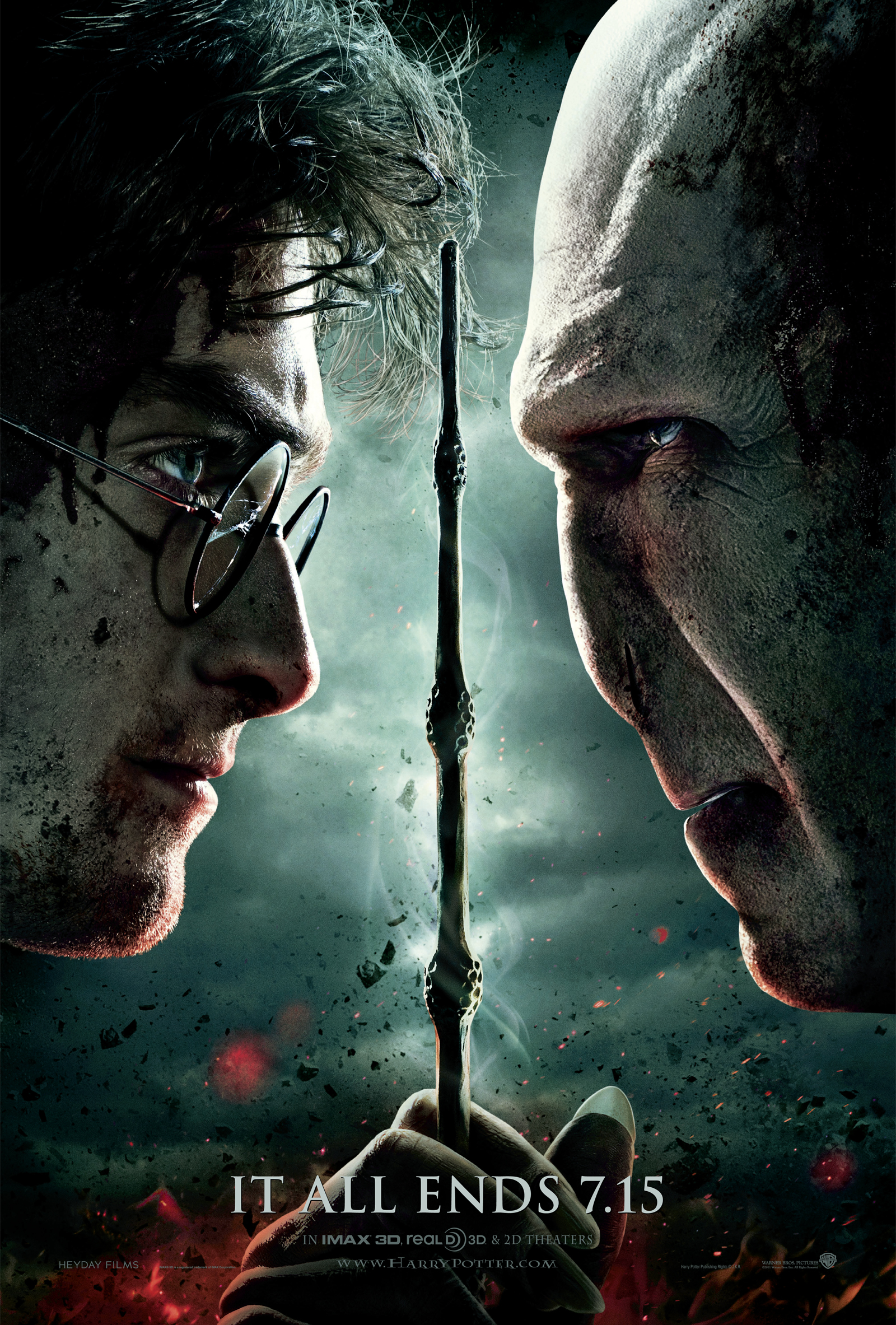
A couple of days ago, the first poster for the last Harry Potter movie was released.  I thought it was awesome in its simplicity.  Harry facing off against Voldemort with only the Wand of Destiny clenched between them.

However, can you think of a more cliched article of fantasy writing than the wand?  What witch, warlock, mage, or sorcerer would not be properly attired without the final touch of this powerful weapon, whether it be a traditional stick of wood or a staff of power...or perhaps even a light saber.

And if you're a writer of fantasy or paranormal, you have probably worked a wand of some sort into your own manuscript.  But as writers, we seek to always bring something new to whatever we create.  And breaking out from old cliched devices is incredibly essential to giving our reader OUR fresh perspective.

JK Rowling does exactly this with her creations, even when they come from traditional lore.  We can learn a lot about putting a fresh spin on an overused device by what she does with her magical wands.

From the very beginning we learn that "the wand chooses the wizard."  Not the other way around.  Wands have their own lore, their own power, their own loyalties, and another's wand will not give you the same results as the one that chose you.  Each wand is unique in its craftsmanship, like the owners they choose, and the wand's maker, like Ollivander, take great pride in their craft and remember every wand sold.

As the series progresses, we see hand-me-down wands, broken wands, brother wands, dueling wands, and spells that tell a lot about wands, such as priori incantatem.  With each of these examples scattered throughout the series, the reader's knowledge of the unique place wands have in this world grows.  Thus, JKR prepares her reader for the final showdown and the most important wand of all.

Since ancient times, sticks of one sort or another have been used as symbols of power and authority over people.  From Pharaoh's was to Moses' rod, to a royal scepter, to the Pope's papal staff -- what person can hold power without brandishing a stick of some sort?  Do we imbue these wands with power because of ancient images of a shepherd's guiding crook, or the disciplinary rod of a father over a child?  Or perhaps they go back even further in our collective memory and hint at a primordial time when the holiest of places, the highest authority, was found in a grove of trees?

Whatever the reason, sticks of wood convey authority and power and JKR used this to her full advantage, with her own twist, in the final book, Deathly Hallows.  The Elder Wand that Harry and Voldemort both seek to claim, the symbol of protection against death, lies in a sacred tomb that Harry refuses to disturb, but Voldemort violates.  It is this attitude that no one matters besides me, contrasted against Harry's self-sacrifice for the love of others, that is ultimately Voldemort's undoing.  No totalitarian authority is allowed to live forever when those oppressed finally are roused to rebel.  Not even the Deathstick, that magical ultimate weapon of mass destruction, can save Voldemort from a simple boy's kindness of heart.  For it is Harry's nonviolent disarming of his classmate Draco which has won the loyalty of the Elder Wand.  And it is his casting of a non-lethal spell into the face of Avada Kedavra, that turns the killing spell back onto its caster, and bring the end to He-Who-Should-Not-Be-Named.

In her intricate plotting, JKR thought deeply of the themes she pursued throughout her series and how these themes would live in the world she created.  Her wands tell us a lot about how the author views the magical world, and our own.  As Dumbledore said, "Voldemort himself created his own worst enemy, just as tyrants everywhere do! Have you any idea how much tyrants fear the people they oppress?" (p. 510, HBP)

Recent events in the MiddleEast have shown what Voldemort learned too late -- even in the real world we witness that how ruthlessly a ruler wields his wand of power is often an indication of how brutally he will be brought down by those who've suffered under him.

Writers -- Look at your symbols, your cliched items of your genre.  What fresh spin can you bring to the tired symbols and tropes?  Think deeply about your story, your world, your hero, and your meaning.  Are your themes reflected throughout?  And if not, what can you do to weave your own Wand of Destiny over your creation and make it truly come alive and sing with your Voice?

Deathly Hallows poster credit
Was scepter image credit

Tuesday, September 28, 2010

Getting Your Themes Across - The Unforgivable Curses

If you want to know what JKR thinks the worst thing one human can do to another is, the answer is right there on the page in Goblet of Fire, chapter 14, "The Unforgivable Curses."  JKR uses a school lesson to give the reader insight into what is to come in the remaining books, as well as a hint toward the deeper meaning underpinning her stories.

Pseudo Mad-Eye Moody, in his first Defense Against the Dark Arts class in Harry's fourth year, uses spiders to teach the students what they need to be on guard against:

1) the Imperius Curse -- Ron mentions this one.  It is cast with "Imperio," and gives the witch or wizard total control over the other person.  Mad-Eye says it takes real strength of character to throw off this curse.

2) the Cruciatus Curse -- Neville names this one, and we later learn that this was the curse which drove his parents insane.  Indeed Barty Crouch, Jr., aka Pseudo Mad-Eye, was one of the Death Eaters who is responsible for leaving Neville essentially an orphan.  Uttering "Crucio" causes total and devastating pain.

3) Avada Kedavra -- As Hermione informs us, is the Killing Curse.  There is no defense against it, and only one person is known to have survived it.  Harry.

Before the end of the series, we will see these curses used by both Death Eaters and good guys.  Harry himself will use the Imperius Curse when he, Ron, and Hermione break into Gringotts in Deathly Hallows.  And at the end of Order of the Phoenix, after Bellatrix kills Sirius, Harry tries to cast the Cruciatus Curse at her, but discovers he really doesn't have what it takes to cause another person serious pain.  Later, he attempts to use it against Snape after he killed Dumbledore at the end of Half-Blood Prince, then succeeds in using it briefly against Amycus Carrow in Deathly Hallows in defense of Prof. McGonagall.

Presented in ascending order of greater offense, JKR thus informs her reader that, in her opinion, the worst things one person can do to another is to control them against their will, cause them devastating pain, and kill them.  She has stated in interviews that she takes death seriously, and that is why you do not see random and casual killing in her stories.  Until the final battle of Hogwarts, each death is presented in such a way as to make the reader truly feel the utter and senseless loss.

JKR has also let her reader know throughout the series what she believes about choice:  "It is our choices, Harry, that show us what we truly are, far more than our abilities." (PS/SS)  That's why taking away one's free will is including on a list with pain and death.

So, with this bit of creative worldbuilding, JKR has created an effective tool for summarizing some of her own key beliefs, crucial themes to the story, and giving clues as to what is to come.  By studying her technique, we see that not only is it truly great to work with themes as a writer, but what's even more cool is when these themes can be inserted openly into the story in a creative, interesting, and most importantly, non-preachy manner.

As a writer, if you were to create your own list of 3 Unforgivable Curses, what would they be?  Would you include the same ones as JKR, or would yours have a different construction?  How would they fit into your current WIP?

Have you created your own piece of worldbuilding to insert into your story that gives your reader insight into your themes and foretell what is yet to come?  And having created such a tool, who will use it?  How will it look different from use by your hero to your antagonist?

Picture credit.

Wednesday, September 15, 2010

Dumbledore's Theme Song

"Ah, music...A magic far beyond all we do here!" (PS p. 95)

Music and Dumbledore. The two just seem to go together, don't they? We know from his chocolate frog card that he "enjoys chamber music" as well as tenpin bowling. But the music vibes deeper than that. Music, for Dumbledore, touches his very soul.

Dumbledore, like his namesake the bumblebee, seems to always be humming about the castle. And then there's his pet, Fawkes, the phoenix. Fawkes not only represents Dumbledore's Patronus, but his anima, a projection of his soul, which restores Harry, not once, not twice, but three times with the power of music.

It is with "eerie, spine-tingling, unearthly" music that Fawkes appears in the Chamber of Secrets and drops the Sorting Hat to Harry, thus giving him the sword of Gryffindor and his means to defeat the Basilisk.

Then, in Goblet of Fire:
...an unearthly and beautiful sound filled the air. ... It was coming from every thread of the light-spun web vibrating around Harry and Voldemort. It was a sound Harry recognized, though he had heard it only once before in his life: phoenix song. It was the sound of hope to Harry. . . the most beautiful and welcome thing he had ever heard in his life. . . . He felt as though the song were inside him instead of just around him. ... It was the sound he connected with Dumbledore, and it was almost as though a friend were speaking in his ear. . . .

Don't break the connection.
In HBP:

When Harry passes along to Dumbledore how he'd answered Scrimgeour's accusation of his being Dumbledore's man through and through with a proud affirmative:
Dumbledore opened his mouth to speak and then closed it again. Behind Harry, Fawkes the phoenix let out a low, soft, musical cry. To Harry’s intense embarrassment, he suddenly realized that Dumbledore's bright blue eyes looked rather watery, and stared hastily at his own knees. (Bloomsbury, 334-35)

At Dumbledore's death in HBP:
And Harry felt, as he had felt about phoenix song before, that the music was inside him, not without: It was his own grief turned magically to song that echoed across the grounds and through the castle windows.

How long they all stood there, listening, he did not know, nor why it seemed to ease their pain a little to listen to the sound of their mourning...

Why would JKR make these connections between Dumbledore and Fawkes and music? Maybe she's playing on a character theme here, on the essence of Dumbledore.

Most writers are familiar with story themes--the central idea, or meaning, of a story. But you can have themes centered on a character as well. Knowing your character's theme helps you as a writer to convey consistently the essence of that character. And if your essence is Bellatrix, according to Hermione when tasting her Polyjuice, that is quite disgusting.

A character theme is not necessarily a main personality trait, though it can be.  Character themes can also focus on a core belief (such as Draco's privileged disdain for mudbloods), a physical feature if it has a profound impact on that character (such as Mad-Eye's mad eye), or something more esoteric (like in Harry's association with the alchemical Philosopher's Stone and Dumbledore's affinity with music and the resurrecting Fawkes).

For an example of how a character theme can play out in the story, let's look at Ron.  Ron is Harry's loyal friend, and the reader sees this in the many words and images JKR writes for Ron -- his constant support and companionship, his defense of Harry when the rest of the school considered him to be the Heir of Slytherin, his welcoming Harry into his home and family, and his willingness to risk his life to save his best friend's.  Even though Ron's loyalty is put to the test once or twice, it is precisely because loyalty is what Ron is all about that he's tested in this manner.

Other character themes which JKR plays with:

  • Hermione -- the Brain (Is that why Ron was attacked by a brain in the DoM? :-) The reader is given numerous references to Hermione's intelligence and love of books.
  • Neville -- yes, Neville is forgetful, but I think his deeper theme would be something like "untapped potential."
  • Uncle Vernon -- Have you ever noticed how often angry words and a purple face are used to describe Harry's "loving" uncle? I think his theme would be raging intolerance.
  • Aunt Petunia -- rigid clean freak--numerous refs to her cleaning, or her spotless home, and think of her reaction to Marge's visit with her dog
  • Hagrid -- monster-loving, almost like muggle-loving, but way more dangerous
  • Snape -- vitriol--as in repressed anger, resentment, and self-blame eating him out from the inside

And finally, again, Dumbledore -- Dumbledore's theme is not simply music, but Phoenix song, music that restores the soul, that resurrects life. It's Dumbledore's theme song which plays deeply into the heart of the Harry Potter saga and which carries Harry through in his final confrontation with Voldemort.

JKR applied her Polyjuice potion to brew out the essence of her main characters, as well as the secondaries.  She knew intimately what they were all about and wove these tidbits into her story to portray them three dimensionally on two-dimensional paper. If you know the heart of your character, then you can breathe life into their being. JKR used these themes through consistent references describing that character's manner of being, words, and actions.

As a writer, have you thought of the essence of your characters?  If you had to describe the look and taste of their Polyjuice potion, would it be disgusting like Bellatrix's,  "the khaki color of a booger" like Goyle's, or a "clear, bright gold" like Harry's?

What other character themes can you see within the Potterverse?  Or, what is one of your own creation?

** Picture credit for Fawkes.

Friday, August 20, 2010

Snape's Gray Undies

It was one of JK Rowling's most memorable scenes from Order of the Phoenix, one that fans could not wait to see come to life on the big screen, and not just because they were eager to view the four marauders together, alive as teenagers.  No, everyone wanted to see Snape and James go at each other.  And many were dying to laugh at Snape's graying underpants.

    Behind [James], the Impediment Jinx was wearing off.  Snape was beginning to inch toward his fallen wand, spitting out soapsuds as he crawled.
   "I wouldn't go out with you if it was a choice between you and the giant squid," said Lilly.
   "Bad luck, Prongs," said Sirius briskly, turning back to Snape.  "OY!"
    But too late; Snape had directed his wand straight at James; there was a flash of light and a gash appeared on the side of James's face, spattering his robes with blood.  James whirled about; a second flash of light later, Snape was hanging upside down in the air, his robes falling over his head to reveal skinny, pallid legs and a pair of graying underpants. (p. 647, OotP)

I do not think those gray undies are thrown in casually for a bit of nasty flavor.  Indeed, I think JKR possibly crafted this whole scene around them.

This view through the Pensieve opens Harry’s eyes to the fact that he’d placed his father on a pedestal that was both unhealthy and unrealistic. The world is not filled with good people and Death Eaters, but ultimately most of us are various shades of gray. And that’s where Snape’s exposed undies come in. Snape, like his undies, is one of the grayest.

Snape was deliberately constructed by his creator to be a man of uncertain allegiance, trusted by few, doubted by many, living in a world of shadows, existing on both sides of the Dumbledore/Voldemort divide. A man who intentionally concealed secrets and motivations.  A character of ambiguity.