Showing posts with label Egyptian Mythology. Show all posts

Friday, January 16, 2015

The Snake and the Wand -- Are They Related?

Can you think of a more cliched article of fantasy writing than the wand?  What witch, warlock, mage, or sorcerer would not be properly attired without the final touch of this powerful weapon, whether it be a traditional stick of wood or a staff of power...or perhaps even a light saber. 

I've been fascinated recently with the wand and its origins. While some people believe the origins of the wand lie in a symbolic representation of masculine power, a phallic symbol, I've been pondering another source. This is the result of the major edits I just finished with Southern Fried Wiccan, which is releasing in March. One of the things I had to work on to get just right was my description of an ancient goddess who gets some screen time on the page (in her mini-sculpture form).


The Snake Goddess of Crete (from ~1600 BCE) is an awesome example of the power of the goddess in antiquity. Not only is she holding two snakes, but she holds them upright, in a display of power, with her breasts -- her female reproductive and nurturing power -- fully bare. She is not a goddess to mess with.

But it is the way she holds the snakes that got me thinking about other early examples of snakes used as rods of power and their origin.

Look at this example of a couple of royal serpents on a staff carried by Thoth, the ancient Egyptian god of knowledge and writing (yes!).

Or this one of a pine cone staff associated with the Egyptian god, Osiris, god of the dead.

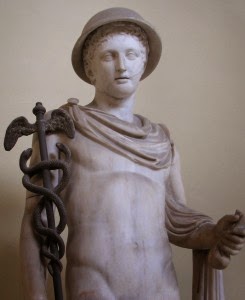
There were many examples of snakes wrapped around sticks from ancient Babylonia and Egypt which eventually made their way into the representation of the caduceus of Hermes.

Other examples:
  • the snake on the Tree of Life in the Garden of Eden (admittedly, a rather large staff)
  • the staff of Moses and the pharaoh's magicians, which turn to serpents as an example of their power
  • the Babylonian god Ningizzida represented by two snakes entwined around a staff

Many of these symbols were not only associated with power, but with medicine and healing as well Handling snakes has long been a dangerous, but in many areas of the world, a necessary occupation. The snake handlers of India are still called upon in rural villages to remove venomous vipers from people's home. Even today in Appalachia, the tradition of snake handling is still practiced in some churches. Those who fear the snake (me!) look with awe on anyone who is fearless enough to engage them with their bare hands.

We know that snake worship was practiced in many ancient societies, and most believe it was due to the snake's symbolic nature of death and renewal through the shedding of its skin, plus it's representation with the underworld as it lives underground. But from a real practical viewpoint, I wonder -- did the wand originate from snake handling? Is that why so many of the earliest depictions of wands and royal staffs frequently incorporate a serpent image as well?  Perhaps people, even in ancient times, who wanted to adopt the power of the snake charmer without...you know...actually touching a snake, picked up a stick and magically assumed its power.

What do you think?

Wednesday, May 23, 2012

The Three Sisters in Harry Potter - Hermione, Ginny and Luna

Clotho, Lachesis and Atropos - the Moirai, or the three sisters of Fate
When I was working up the post on Luna -- The Eye of Harry a few months ago, it struck me that JK Rowling had used cat imagery with each of Harry's three main female friends.  Hermione is transformed into a cat in Chamber of Secrets through a Polyjuice Potion used improperly.  Luna wears the Gryffindor Lion hat in Order of the Phoenix as a vision of a modern Sekhmet.  And also in OotP, when Harry is with the Weasley kids awaiting news of their father after Nagini's attack, he sees Ginny "curled like a cat on her chair, but her eyes were open; Harry could see them reflecting the firelight (p. 423, Bloomsbury)."  Very cat-like imagery associated with this daughter of a mother who was once described as a "sabre-toothed tiger" (CoS, ch. 3).

A triple Hekate

Why would JKR use cat imagery to link all three of her young female leads?  I've been pondering this for a while, and I think the answer lies, like the hints do, in mythology.  As Luna's lion hat was a tip toward the ancient Egyptian goddess Sekhment, so too were many ancient goddess associated with the cat family.  And when we're talking about goddesses, the threefold imagery is common across many cultures.  Whether  we look to the maiden/mother/crone manifestation so popular with Neopagans, a single goddess viewed in triplicate as with Hecate, the three mothers of the Matres or Matrones, or three sisters such as the Fates (or Moirai), the Norns, the original three Muses (later extended to seven or nine), or the Graces, it seems that frequently the fullness of the feminine divine was expressed in triadic.  Perhaps this was as a matter of balance.  A duality implies polar opposites, tension, but three suggests fruition, a stabilized harmony.
The Muses: Clio, Euterpe and Thalia
by Eustache Le Sueur

Of the triple goddesses mentioned above, while I think JKR employs maiden/mother/crone imagery within HP by the use of any of the three girls as maiden, Molly Weasley as Mother, and Minerva McGonagall (or Augusta Longbottom) as Crone, I don't think that's the triune goddess she is going for by linking Hermione, Ginny and Luna.  Instead, I think she seeks to invoke the Three Sisters.

The Fates (or Morai) were known to spin the fates of all people.  Clotho spins the thread creating life; Lachesis uses a scale to allot or determine the portion of life each will receive and a cornucopia to dispense their fortune, and Atropos snips the thread bringing that life to an end.  Ginny, as a younger version of her mother of seven, (her middle name is Molly), signifies the creation of life.  Indeed, to Harry under the effects of the love potion, Amortentia, Ginny's smell is of spring flowers.  Hermione, with her keen mind and her sense of justice, represents the scales of Justice of Lachesis.  It is fitting that she goes into a legal career, fighting for the lives of all magical creatures, when she graduates Hogwarts.  Luna, with one eye always in tune with a world beyond our own, and an ear which hears the voices beyond the veil, is aligned with the bringer of death, Atropos.  Interestingly, there are a variety of needlework imagery associated with Hermione, from successfully changing a match to a needle in her first Transfiguration class, to the knitting of the hats for the house elves, to the scissors she uses to trim Harry's hair while on the run in Deathly Hallows.

Wadjet-Bast

But the three sisters are not only found in the Fates or Graces.  In looking back to the Egyptian mythology from which the cat-like imagery originated, we see many sister-goddesses as well.  Although relationships among the Egyptian deities is fairly fluid as the mythology evolved and developed over thousands of years, there are three goddesses who were considered daughters of Ra, and thus sisters -- Hathor, Bastet, and Sekhmet -- the last two with feline representation.  All three of these goddesses were at time considered to be the Eye of Ra

Sekhmet
The Eye of Ra (Re) was a powerful, feminine element in Egyptian mythology, personified by a variety of goddesses, and depicted as an all-seeing eye and solar disk.  The Eye was Ra's creative partner and protector.

"The Eye goddess acts as mother, sibling, consort, and daughter of the sun god. She is his partner in the creative cycle in which he begets the renewed form of himself that is born at dawn. The Eye's violent aspect defends Ra against the agents of disorder that threaten his rule. This dangerous aspect of the Eye goddess is often represented by a lioness or by the uraeus, or cobra, a symbol of protection and royal authority." (http://en.wikipedia.org/wiki/Eye_of_Ra)

Hermione, Ginny and Luna are three very different girls from three different families who come together for a common goal, and though there is at times conflict between them, in the end, they find a harmonious balance as they seek to aid and protect Harry in his goal to vanquish Voldemort.  In many ways, Luna is the opposite of Hermione, with her belief in a logic outside the norm and Hermione's firmly rooted in reality.  Likewise, Ginny embodies the fiery elements of the Sun, whereas Luna the more mystical, shaded elements of the Moon.  Ginny is a natural risk-taker; Hermione has to force herself to challenge authority.  Hermione is Muggle-born, Ginny is pure blood, and Luna, though born of both witch and wizard, lives on the outskirts of magical society, both through the eccentricities of her father and his work at the Quibbler as well as her own non-conformist views.  In their role of assisting Harry (Ra/Horus) Hermione has keen insight into the problem at hand, Ginny provides fearless action often when others are hesitant as shown in the battle at the Department of Mysteries, and Luna sees what others cannot or will not.

In the defeat of Voldemort, Luna leads Harry to the diadem of Ravenclaw and the final Horcrux (aside from Harry himself) to be found, Ginny participated in the Battle and comforted the wounded during the lull between the fighting.  And Hermione, of course, was with Harry throughout the whole Horcrux hunt, having the honor of dispatching that part of Voldemort's soul lodged within Hufflepuff's cup.

The Graces at Pompeii

Perhaps the most telling moment of how these three girls become Sisters occurs during the Battle of Hogwarts when they join together to fight against the female who epitomizes the dark side of the Goddess: Bellatrix.

"Bellatrix was still fighting too, fifty yards away from Voldemort, and like her master she duelled three at once: Hermione, Ginny and Luna, all battling their hardest, but Bellatrix was equal to them, and Harry’s attention was diverted as a Killing Curse shot so close to Ginny that she missed death by an inch--" (p. 589, Deathly Hallows, Bloomsbury)

It is, of course, at this point that Mrs. Weasley steps in, and in her sabre-tooth tiger form of mother and protector, utters her most famous line -- "NOT MY DAUGHTER, YOU BITCH!" -- and puts an end to the demonic evil that is Bellatrix.

But again -- the girls -- united as one, brought together for a common goal, became sisters in their role as the Eye of Ra and protector of Harry.  For JK Rowling, I think it was important to balance out a story which focused on a male hero and villain with the overwhelming support of the Female in all her divine glory.  Through Hermione, Ginny and Luna, JK Rowling was able to sketch a portrayal of various aspects of womanhood, sisterhood, and the balance in a relationship of very different people.  It also emphasizes JK Rowling's theme that family is not merely a matter of blood kin.

If there is one thing I would change to have hit this theme home even more, I'd have made Mrs. Weasley's use of the word daughter plural rather than singular.

Question -- as Hathor is often associated with cows, I'd think it interesting if JKR had included any bovine references or images within Potterverse, but haven't yet found any.  If you know of one, or other needlework imagery associated with Ginny or Luna, please comment below!

(Check Out JK Rowling's Newest Release -- Harry Potter and the Cursed Child here!) 

Thursday, December 1, 2011

The Blood of Lily


Yes, I'm on an Egyptian mythology roll, because in doing last week's post on Luna as the Eye of Harry/Horus, I discovered quite a few other links JK Rowling made to these old myths.  And here's one that seems so obvious to me now, that I don't know why I didn't see it before.

When I first started reading the Potter series, I always wondered with each new book why Harry had to return to the dreaded Dursleys each summer.  Sure, as a writer I understood Rowling's desire to frame and pattern the story with Harry's annual exodus and return to the Muggle world, but as a reader, I kept wondering why Harry couldn't be allowed to go live with the Weasleys.

Of course this was all explained when Dumbledore talked about the spell of protection that he'd used to keep Voldemort from finding and harming Harry as long as he could call #4 Privet Drive his home.  A spell that was born of the shared blood between Petunia and Lily.

Wednesday, November 23, 2011

Luna -- The Eye of Harry

Remember Luna in her lion hat in the match against Slytherin?  That was quite a good comic gag, wasn't it?  Quirky, weird Luna knew how to make her classmates laugh, whether with her or at her.

But rarely does JK Rowling weave in any comic element without layering a subtle level of meaning beneath it.  And Luna's hats packs quite a roar.

   'Hello,' said a vague and dreamy voice from behind them. Harry looked up: Luna Lovegood had drifted over from the Ravenclaw table. Many people were staring at her and a few were openly laughing and pointing; she had managed to procure a hat shaped like a life-size lion's head, which was perched precariously on her head.
   'I'm supporting Gryffindor,' said Luna, pointing unnecessarily at her hat. 'Look what it does...'
   She reached up and tapped the hat with her wand. It opened its mouth wide and gave an extremely realistic roar that made everyone in the vicinity jump.
   'It's good, isn't it?' said Luna happily. 'I wanted to have it chewing up a serpent to represent Slytherin, you know, but there wasn't time.' (p. 357, OotP, Bloomsbury)

Now, compare Luna in her roaring lion's hat with the images of the ancient Egyptian goddess Bast (or Bastet) below:

Friday, September 16, 2011

A Quest for That Final, Missing Element

Okay all you people who did not vote for Egyptian Mythology when I polled earlier on what you'd most like to see next on the blog. I'm going to subject you to one post of it anyway! Because, you know what? I love it!!! And it's my blog!!!!! Mwahahaha ha!!

You know another thing I love, and you can ask my kids to verify this, saying "I told you so!"

In putting together this Conflicts of Myth workshop that I'm currently teaching, I revisited one of my ancient writings on Harry Potter from...can you believe this...4 years ago! Before Deathly Hallows came out! Yes, I'm that obsessed, I was even writing then.

I carefully, lovingly pieced together a magnificent theory on what was to come in Deathly Hallows involving the revealing of One Last Memory -- the crucial knowledge of what actually happened at Godric's Hollow from one who was there...Severus Snape!

My theory was brilliant.  It was detailed!  It filled in every loophole!!!  Alas, it was also totally wrong. :-(  Sob!

(Actually, my current theory is that JK Rowling read my brilliant editorial, knew that I was on to her, and quickly had to replot and rewrite the whole last section of Deathly Hallows because she just couldn't accept having been found-out beforehand.  Plus, we DID get one last memory involving old Severus, just not in the way I foretold.)

Ah, hum.  So, anyway, where was I?  Oh, yes, the Egyptian Mythology thingie.  In reviewing this ancient bit of bullet-riddled theory, I came across one section that actually appeals to me even more now that we know the full revelation of Voldemort's Horcruxes.  And it involves one of my other favorite theories, the Eye of Horus.  Since I've already covered that one in depth on the blog, I'll simply refer you to that post for background.

But, knowing that most of you will not click that link and read, very simply, Mad-Eye Moody's magical eye seems to be a link to the Eye of Horus.  The Eye was an amulet that provided protection for its bearer, until it cracked; it would turn back any evil directed its way -- much as Lily's charm did for Harry.  Lily's charm, an amulet, get it?  Metaphorically speaking, Lily pinned an Eye of Horus on her beloved son, just as mothers in Turkey still do today.  (Though they tend to pin it to their clothes rather than their skin.)

JK Rowling has worked several of these Egyptian myths into the Harry Potter series, and one day I'll tell you the underlying reason why I think she did so, but for today...I just want to focus on the Eye (get it, focus, eye). (Yes, I know it seems like I've been drinking and I'll probably erase half of this in the morning, but for now it's fun.  And no, I haven't.)

Anyway...here's one of the interesting meanings of the Eye of Horus.  You'll not see this coming, I can guarantee it.

It was an ancient mathematical calculator!!

See. Told ya you wouldn't foresee that!

Each part of the eye was a fraction, that when added together equaled one.  Here's an image that shows each part of the Eye with its fraction:


Now, the funny thing about this ancient fractional calculator is that it doesn't quite work.  At least it doesn't work by modern standards.  See, if you add all those fractions together you don't get the whole number one...exactly.  And, no, it's not because the ancients couldn't do math.  It's because they thought a bit differently than we do.  It's because they valued something beyond pinpoint mathematical accuracy.

The element of the spirit.

The six parts which made up the Eye of Horus were used as mathematical symbols to represent decreasing fractions progressively halved (1/2, 1/4, 1/8, 1/16, 1/32, 1/64). Each of these Eye symbols and fractions also represented a sense (smell, sight, thought, hearing, taste, and touch respectively). The six parts together embodied a whole, a complete--except that they total 63/64, missing one small fraction, 1/64...the 7th missing  magical element.

There was an esoteric meaning associated with this missing fraction. “The eye is the part of the body able to perceive light, and is therefore the symbol for spiritual ability.”[45] The missing fraction of the eye represented a magical element supplied by Thoth, which cannot be quantified, but without which nothing, and no one, is complete.[46].

Because this missing magical element is so important, JKR left us two direct clues regarding it within the Half-Blood Prince text--Golpalott’s Third Law and Quintessence: A Quest.  But more on that in a minute.  First, let's look at these six fractions and how they relate to the Horcruxes.

Let’s see--Tom Riddle's teen voice was recorded in a diary for a young girl to hear and follow years later, a ring is worn on fingers which touches things, a locket holds something you can look at, you can drink (taste) out of a cup, and Nagini, well, snakes are known for their keen and unusual sense of smell. In fact, in the CoS book as opposed to the movie, after Fawkes blinded it, the basilisk had to sniff Harry out. Coincidence? I think not!

Here's the parts of the Eye of Horus and how I think they played out in JKR's Horcruxes:


Eye of Horus partCorresponding HorcruxFraction
HearingTom Riddle's voice thru his diary1/16
TouchPeverell ring1/64
SightSlytherin's locket1/4
TasteHufflepuff's cup1/32
ThoughtRavenclaw Diadem (wit beyond measure)1/8
SmellNagini1/2


I'll be honest with you, while this is fun to speculate, even I'm not sure that JKR intended these connections.  One of the key doubts I have always had regarding this theory is due to the order of the fractions related to the Horcruxes.  If I were the author writing it, I would have the Horcruxes created in the fractions' descending order starting from 1/2, to 1/4 until 1/64.  That makes perfect sense in keeping with the decreasing divisions of Voldemort's soul as he rips it apart with each new murder.

However, JKR always plays rather loosely with her mythical links, and there is one final piece of evidence that strengthens my belief that she was at least giving a nod to the Eye, if not quite as literally as I would like to interpret.  Golpalott's Law and Quintessence, a Quest both point to the Eye's same final, missing element.

In HBP, Golpalott’s Third Law is a potions’ law that Harry, and many readers, find quite difficult to understand.
Hermione recited at top speed: “Golpalott’s-Third-Law-states-
that-the-antidote-for-a-blended-poison-will-be-equal-to-more-
than-the-sum-of-the-antidotes-for-each-of-the-separate-components.”

Then Slughorn clarifies, somewhat:

“...which means, of course, that assuming we have achieved correct identification of the potion’s ingredients by Scarpin’s Revelaspell, our primary aim is not the relatively simple one of selecting antidotes to those ingredients in and of themselves, but to find that added component which will, by an almost alchemical process, transform these disparate elements--”[47]

What all this means is that there’s an intuitive, almost alchemical knowledge which comes to bear in creating an antidote to a blended potion. Secret knowledge of an important missing element, so to speak.

In Chapter 15 of HBP, “The Unbreakable Vow,” Harry, while trying to avoid being dragged into Ron’s grumblings against Hermione, is reading a book for Charms, Quintessence: A Quest. I believe this is a very sly reference from JKR, to reinforce the Eye of Horus analogy and the stated Golpalott’s Law. Just to make sure we get the point.

Quintessence is an alchemical term for the mystical fifth element. Earth, air, water, and fire are the traditional four elements which make up everything that exists. In Harry Potter, JKR has confirmed that each Hogwarts House represents one of these elements: Earth = Hufflepuff, Air = Ravenclaw, Water = Slytherin, and Fire = Gryffindor.[48] And each of these elements is represented in the Horcruxes, with Gryffindor's sword being the most common item of destruction.  But there is a fifth element, quintessence, which I think plays an even stronger role in the series, indeed is the embodiment of Harry’s personal quest.

From The Alchemy Lab:
The Quintessence is the fifth element with which the alchemists could work. It was the essential presence of something or someone, the living thing itself that animated or gave something its deepest characteristics. The Quintessence partakes of both the Above and the Below, the mental as well as the material. It can be thought of as the ethereal embodiment of the life force that we encounter in dreams and altered states of consciousness. It is the purest individual essence of something that we must unveil and understand in order to transform it.
Essentially, quintessence is spirit, it is soul. Quintessence, for JK Rowling, is embodied in Harry.

Voldemort didn't intend to make Harry a Horcrux.  Harry's the missing element.  He's the fraction of the equation which Voldemort could not comprehend, and thus did not take into account.  He's that most important final element that brought about the failure of Voldemort's dark magic to secure eternal life.

As writers, this is the part of my post where I turn to how we can use these lessons learned from studying JK Rowling in our own stories...blah blah blah.  Honestly, I doubt there's many of us that obsessive who will plot a subtextual reference to this extreme.  And if you are one of those, you don't need me to point out how to do this yourself!

But, I'd love to know what you think.  Am I off on a wild crumple-horned snorkack chase here? Or do you think, just maybe, JKR may have been pulling the Quintessence over our Eyes?


P.S. - Need a professional edit on your manuscript before you submit or publish direct? Be sure to check out my services!

Monday, August 1, 2011

Captain Neville and his Crew of Bodyguards

Bill Weasley worked for Gringotts as a curse-breaker in Egypt. The whole Weasley clan visited Bill in Egypt before the beginning of Prisoner of Azkaban. The referee for the Quidditch World Cup was Egyptian. The tour Dumbledore's old friend Elphias Doge took once leaving Hogwarts included a stop in Egypt to observe the experiments of Egyptian alchemists. And we must not forget that Fawkes the phoenix and the sphinx in the Triwizard maze have their homes in ancient Egypt.

Think these Egyptian references are just casually tossed in for a bit of exotic flavor? Then you don't know JK Rowling.

JKR points the readers' attention to Egypt for a very deliberate purpose. 

Ancient Egypt, as the mythical home of alchemy under Thoth, was a source for many of JKR's subtextual mythical allusions. In Dipping Into the Universal Well, I documented how JKR used the myth of Egypt's holy family, Osiris-Isis-Horus, to enrich and deepen the story of Harry's past and his conflict with Voldemort, who, as the murderer of Harry's parents is likened to Seth as the killer of Osiris and seeking to kill Horus. Indeed, Harry's story comes to conclusion with his defeat of Voldemort, which restores order and peace to his divided land, just as when Horus defeated Seth.

There is a different myth involving Seth which I would like to explore further as it relates more strongly to the ending of Deathly Hallows. Seth (sometimes spelled Set) is a complex figure in ancient Egyptian mythology. In his earlier forms, he was a protector of the great sun god Ra (Re), journeying with him on his daily voyage in his solar bark across the heavens of day and through the dark underworld of the night. Seth's job was to fight off the great and evil serpent Apep, who battled daily to swallow and kill Ra, and thus plunge the world into the darkness of death and despair.

Apep was the most feared mythical creature in all of Egypt. The dead were buried with amulets and spells to use against him as it was believed that Apep traveled in the Underworld seeking with his army of fiends to eat the souls of the dead. (The original Death Eaters). While Apep's followers were known as the "Children of Rebellion," those special gods who protected Ra were sometimes called the "Children of Horus" (Budge).

However, Seth was also the god of storms, the dessert, and chaos, and partly due to political reasons, over time, his religious cult gradually weakened. Seth became a darker god, associated in evil characteristics with Apep rather than as Ra's protector fighting him off. Eventually, Seth and Apep were seen almost as one.

Can you see yet why Voldemort killed Snape via a bite from Nagini rather than Avada Kedavra Snape himself?

While in the earlier Osiris-Isis-Horus myth allusions, Voldemort is likened to Seth as the murderer of Osiris and attempted killer of the baby Horus, in this solar bark myth Seth becomes Snape. Who but Snape does daily battle interceding between the solar god (either Dumbledore or Harry, depending on how you look at it) and the serpent-man, destroyer of lives and souls, Voldemort? Snape even boasts in Order of the Phoenix that it is his job to play the double agent, to battle where no one else dare go.

As Seth is darkened throughout the millennia due to the changing political powers around him, so Snape is viewed darker and more evil as a result of the actions demanded due to his allegiance to Dumbledore. Snape is shown as less a trusted companion of Dumbledore and more as a true Death Eater and murderer.

In the Ra-Seth-Apep myth, the only way the great Apep can possibly hope to get to Ra and finish him off is to kill off his greatest protector first. Thus Nagini, the pure embodiment of Voldemort's Apep-like evil, is the one who deliver's Harry's last protector his final death blow.

But Ra did not travel in his solar ship alone with only Seth for protection. Ra had friends, other gods who traveled along on his daily journeys to assist when confronted by storms and other natural disasters. These "children of Horus" guarded Ra and ensured that he successfully completed his journey.

As Harry approaches his final destination in his quest to eliminate Lord Voldemort and restore order and peace to the wizarding world, he enters Hogwarts in a most unusual way. And you can guarantee, when JKR writes something that seems slightly off, she's up to something tricky.

A portal opens up behind the painting of Ariana revealing "smooth stone steps on the other side: it looked as though the passageway had been there for years. Brass lamps hung from the walls and the earthy floor was worn and smooth; as they walked, their shadows rippled, fan-like, across the wall." (p. 461, Bloomsbury)

Once they arrive inside the Room of Requirement, Harry couldn't recognize the room. It now looked like an enormous interior of "a particularly sumptuous tree hours, or perhaps a gigantic ship's cabin. Multicoloured hammocks were strung from the ceiling and from a balcony that ran around the dark wood-panelled and windowless walls." (p. 464, Bloomsbury).

The portal between Aberforth's Hog's Head and Neville's newly commissioned Room of Requirement appears of stones washed smooth from centuries of water, with watery ripple-like shadows fanning the walls. Once inside the room, it as if Harry and friends have boarded a ship, with hammocks rather than beds and even a railing-like balcony that seems completely unnecessary in a room that does not open to the outdoors or even have windows. Even those brass lamps along the way hint at the brass fittings of a ship.

And Harry, Ron, and Hermione are escorted on board by the captain himself. "Neville's the man" Longbottom.

Longbottom. I'd long wondered why JKR had chosen such an odd surname for one of her lead characters. But, then, JKR is known for her odd names. Odd names that almost always carry a hint of deeper meaning.

While others have speculated that Longbottom is a nod to Tolkien's longbottom leaf tobacco, or perhaps drawn from an old English word that means powerful, a long bottom is also a type of boat. And the boats of ancient Egypt, which used many oarsmen, required long bottoms to navigate.

Stretching it, you think? Maybe. But the fact remains that JKR used ship imagery to describe the Room of Requirement and the boarding of not only of the Trio but all the family and friends who entered through this gangplank to fight the Battle of Hogwarts as well. Thus placing Neville, our captain, and the one man who truly "gets" the Room of Requirement, and also Harry's prophetic twin, as the man to slay the great serpent Apep now that Seth was gone.

According to the ancient Egyptian priests, who ritually mocked and killed an effigy of Apep to purge the land of evil, this great serpent could be killed by a process which involved "fettering" Apep, setting fire to him, or smiting him with a lance. Hermione tried to set fire to Nagini by use of the confringo spell in Bathilda Bagshot's house in Godric's Hollow, which caused so much heat it seared the back of Harry's hand. Voldemort himself fettered his pet in a protective magical cage. But it was Neville Longbottom who gave the great serpent her final blow by smiting her with Gryffindor's sword.

Through the efforts of this crew of friends, the children of Horus, Harry is able to face Voldemort in the Great Hall and as the red-gold sun arises over the horizon, put an end to the man who has plunged their world into darkness and chaos. The Sun god Ra has defeated the dark serpent and his solar bark can continue along its natural course.

JKR uses classical myths to help deepen her story and to provide a rich subtext of clues to guide her readers to uncover the mysteries of the series. You'll notice that aside from some names of creatures or characters (Minerva as the goddess of education and war) JKR rarely refers to the myths overtly. Instead, she uses key points of description, such as the Room of Requirement looking like a cabin of a ship, and paralleling of action and story, such as aligning Voldemort with the great serpent Apep, intent on killing Ra and plunging the world into death and destruction. Such subtle maneuvering created a layered read filled with modern and classic allusions which the reader delighted in exploring the depths of through many subsequent re-reads.

How would a writer go about doing this herself? For me, the process would have to start with the story you seek to tell. Not all stories will be suited to multiple layers of subtext and allusion. But if you think yours is and this technique appeals to you, then take a moment to observe the forest of your story rather than the trees.

Get an overview. What's your story about, its meaning, its theme?

One you've got a succinct understanding of your purpose, then compare your overview with other classical stories or myths you've heard before. Is yours the story of a heroine getting sucked into the underworld of despair and having to learn to fight her way out? Then you might want to look at Persephone. If you've got a romantic couple battling each other for trust, then consider Eros and Psyche. Or, if you're writing horror and you have a crazed, bloodthirsty woman on the loose, you might take a peek at Sekhmet.

Then, once you've got your connection, consider the similarities of your story, the points you can make in comparison. Can you weave a similar description in here or there? Can you have a plot point match its ancient cousin? Above all, can you do so without drawing obvious attention to what you're doing? The object of this type of subtext is not to say "lookee, see how brilliant I am," but rather to enrich your story's meaning and your reader's enjoyment.

Have you ever worked mythical allusions into writing your story?  If so, what points did you make in comparison?

This post is part of the Final Chapter series, which is now collected on the Kindle for ease of reading as The Boy Who Lived Comes to Life totals 100 pages!

Sources:
The gods of the Egyptians: or, Studies in Egyptian mythology, Volume 1, by Sir Ernest Alfred Wallis Budge
The Egyptian Heaven and Hell: by Sir Ernest Alfred Wallis Budge

Monday, July 25, 2011

Mad-Eye's Magical Eye

Because I've got a new toy I want to play with today (CommentLuv!), and because I don't yet have my blog post ready, I'm re-posting one of my favorite posts (with updates!!) from the early days of this blog. However, I see from the poll over to the right, that not as many of you are as in love with the Egyptian mythological references in Harry Potter as I am!!  That's ok, you can suffer through today. :-)

Actually, you may want to comment anyway because my new toy is supposed to show/link to your last blog post on YOUR blog when you comment on mine.  I want to make sure this new widget works properly before I put a new post up.

So...play along. Please....Thanks!

**^**

Look at the three images I have on this post and see if you recognize any similarities.

Let's start with the first image, the ancient Egyptian Eye of Horus.

The Eye of Horus was an amulet of healing and resurrection. One of the most revered and powerful amulets in ancient Egypt, the Eye provided protection from evil. It was a symbol of royal strength and assisted in the rebirth of the deceased.

As the granddaddy of apotropaic amulets, meaning a talisman that turns back harm or evil, the Eye was so popular that it spread throughout the region and the centuries, morphing and adapting to various cultures, but always retaining the staring single eye. It is truly very old magic.

nazar boncugu

The Eye still exists in various incarnations even today. It is very popular throughout the Middle East, especially in Turkey where it is known as nazar boncugu. In Turkey you will still see this amulet nailed over doors to homes, decorating the hulls of ships, and pinned to the clothing of young children, placed there protectively by their loving mothers. (Actually, you see it EVERYWHERE! :-)


Now let's look at Mad-Eye's mad and magical eye.


From Goblet of Fire:
But it was the man's eyes that made him frightening.


One of them was small, dark, and beady.  The other was large, round as a coin, and a vivid, electric blue.  The blue eye was moving ceaselessly, without blinking, and was rolling up, down, and from side to side, quite independently of the normal eye -- and then it rolled right over, pointing into the back of the man's head, so that all they could see was whiteness.  (p. 184-185)

Hmm. An all-seeing round eye with the colors of black, blue, and white... Ya think there's a connection?

A few years ago, when E.L. Fossa of Wizarding World Press pointed out to me the similarities between JKR's creation and the Turkish nazar boncugu, I felt a bit dimwitted.  Here I was, married to a Turk, having lived in Turkey many years, with many boncuks hanging in my house, on my keychain, or pinned to my children's clothes when they were babies, and I'd not made that connection.  Yet, this was the early days of my induction into the murky subtext of Harry Potter and I was only then learning how to seek below the surface.


If I'd had any remaining doubts that JKR intended for the reader to make these connections to the nazar boncugu or the Eye of Horus, it was  was when she had Umbridge nail Mad-Eye's glass eye to her office door just like the Turks do with their good luck bead that cinched it for me.  On the surface, Umbridge's action was just a bit odd.  And you can bet, whenever JKR is doing something that seems odd or slightly out of place, that she's getting at a deeper meaning, most likely using a mythological reference.

But ... why would JKR pin a benevolent amulet onto a character who in his first appearance is a Death Eater and fraud?  I think there's an initial reason, and then a deeper one that leads to the underlying mystery of the series.

First the initial reason -- the Eye of Horus, as well as its descendant, the nazar boncugu, are amulets that represent the protection of an all-seeing divinity.  In Goblet of Fire, pseudo Mad-Eye (aka Barty Crouch, Jr.) fills this role.  He sees all, knows much more than any other character what is truly going on, and is bent on protecting Harry and getting him through as champion in the Tri-Wizard Tournament.  Unfortunately, all this protection is aimed at sacrificing Harry to his lord and master, Voldemort.

However, in the end, despite himself, Crouch's protection works effectively.  It is Barty Crouch as Mad-Eye who taught Harry how to throw off the Imperius curse, an ability that helps Harry survive his encounter with the Dark Lord and return safely to Hogwarts.

 For a deeper analysis of these ancient references -- JK Rowling utilized ancient myths, I believe, to show the continuity of belief....Jung's universal collective subconscious, if you will.  What people have believed for two thousand years, still rings true today...as long as you change the clothes and settings.  Good versus Evil, the eternal nature of Love, our need to fight our Shadow and triumph.  All this rang as true to Egyptian ears three thousand years ago as it does to ours today.

As writers, we have the option of working sub-textual meaning into our stories.  If we do so with skill and resonance, as JKR has done with Moody's eye, then we've provided a whole new layer for the reader to engage within our pages, time and time again.

Notice that JKR never says the words Horus or Egyptian mythology in the text.  Nor does she point out directly the resemblance of Mad-Eye's bulging blue eye to the Turkish good luck charm.  She simply describes her creation in a similar way, has it utilized in a related manner, points the reader in the direction of Turkey and Egypt in other places (Bill's work in Egypt, the Egyptian Quidditch referee, and the mention of Ludo Bagman's win over the Turkish Quidditch team).  Thus, with such subtle but deliberate hints, the game master leaves these little Easter Egg delights for the reader to discover.

That's the joy of subtext and why layers of it added to your writing bring your reader back to your story time and time again.  Readers delight in being able to read a Potter novel for the second, third, (cough, sixth, cough) time and still discover meaning that was not evident on an earlier read.

So, why would JKR draw so much attention to this particular ancient Eygptian amulet?  I have a theory and it points to the Horcruxes.  But that's a huge 'nother post. (Actually, it became two. You can read When is a Horcrux not a Horcrux here, and That Deathly Hallows Symbol here.


Have you layered in subtext in your writing? What technique have you found to be the most useful for referring to a theme, myth, or item below the surface?


Photo credits:
Eye of Horus
Nazar Boncugu
Mad-Eye Moody 
Door with Boncuk, Turkey

Tuesday, May 17, 2011

Dipping Into the Universal Well

Do you remember back to your high school days (or maybe you're still in them!), when your English Lit teacher loved to drone on about the subtextual layers in works from authors such as Faulkner or Shakespeare? Did Shakespeare really intend in Hamlet for the poisoning of the old king through his ear to speak to the veracity of what one hears through them?  I mean really, what author could have intended every single one of those thematic details English teachers like to needle out and torment their students with on tests? ;-)

But honestly, I have to say that the sort of minute analysis I suffered through in English class was a drop in the cauldron compared to the frenzy I whole-heartedly engaged with once Harry Potter hit the scene. Talk about your theories and comparisons to every fable, myth, and work of literature ever created! Surely, JK Rowling couldn't have meant but a small fraction of them.

Or could she?

To better analyze how these subtextual references work for a writer, let me do what all writers do. Let me tell you a story...

This one concerns a young man often called the orphan because his father was murdered by an evil lord, who then tried to kill the young orphan as well. Fortunately, the orphan's magical mother was able to save his life, and so he grew to adulthood with the desire to right the great wrongs the evil lord had committed, avenge his father's murder, and reclaim his father's inheritance, which the evil lord had stolen from him. Numerous times the orphan faced the evil lord, but neither was able to finish off the other. For years, they battled bitterly and often violently to prove themselves in escalating challenges, which caused great trouble in their divided lands.  Finally, the orphan triumphed, and with his success, reunited the people.  The evil lord was banished for eternity.

But wait, you say.  You know this story.  It's Harry Potter!

And yet, the story I was conveying is an Egyptian myth several thousand years old.

Osiris was the wise deity ruler over Egypt with his wife Isis by his side. Together they brought prosperity, peace, and order to Egypt.  However, Seth -- Osiris and Isis' brother -- seeing what they had, decided to steal the throne for himself.  He plotted to kill Osiris and then Isis' son, Horus, as well. Powerfully magical, Isis was able to protect her son from Seth's evil attack.

Horus was destined to avenge his father's murder when he was old enough to reclaim his inheritance. Horus and Seth battled for many years until finally the combatants were called before the Ennead -- a council of nine prevailing gods -- to decide the matter by tribunal. Proving himself the better, Horus was awarded his father's position, reclaimed his birthright, and united the lands of Upper and Lower Egypt forever after. Depending on the version of the myth, Seth was either banished or killed.

Sunday, November 28, 2010

That Deathly Hallows Symbol

Updated 7/7/11

In celebration of Deathly Hallows' release, I'm going to do something I don't usually do on this blog. I'm going to indulge myself in a post that is truly more fan speculation rather than writer analysis. What can I say? I came to Harry Potter first and foremost as a fan!

Back in the summer of 2007, after the cover for Deathly Hallows had been revealed, but before the book had been released, I, like many other HP fanatics, was caught up in exploring and speculating on every aspect of the cover for possible clues toward the forthcoming story. I was especially fascinated with that mysterious, geometric symbol on the spine of the Bloomsbury UK cover.

Having already spent a good deal of time analyzing and presenting workshops on the alchemical and Egyptian mythological underpinning of the series, I looked there for an understanding of the symbol. I completed an editorial analyzing it as the last segment of a 3-part essay on Egyptian Mythology in Harry Potter that was published on Mugglenet.com.

Unfortunately, the editors at Mugglenet were so busy posting an onslaught of last minute theories before the final revelation, that they didn't get the last two parts of my series posted until the comment section had been shut down ahead of DH's release to prevent spoilers. So, I never got feedback on my, of course, brilliant theories! ;-)

But now that I have a blog of my own, I can subject you all to this last, lost speculation! So, if you're ready to revisit those long-gone wonderful times of plastering the Internet with wild theories before the next Harry Potter release, then sit back and grab something good to drink, because when I dip into fan speculation, I tend to get long-winded.

Harry's Sacred Egyptian Triangle
In the introduction to the essay linked above, I said:

And now for what I consider the most exciting part of this three-part editorial -- that symbol on the spine of the Bloomsbury children's cover, the one that has inspired much discussion, sparked such controversy, and appeared as the key into the last round of W.O.M.B.A.T. questions. That sign, in my opinion, is a decidedly Egyptian symbol with some mixed-in alchemical and Masonic esoteric meaning. Essentially, I think it is a composite sign of JKR’s own creation -- an Egyptian Triangle with the Eye of Horus and Tree of Life layered on top.
(My editorial is very long, but if you're interested, it will give you greater insight to the theories below).


My argument was thus:

1) The triangle represents the sacred Egyptian Triangle or Golden Triangle, personified by the goddess Isis, her deceased husband Osiris, and their child Horus. These three together formed the Egyptian holy family and thus symbolized eternal love and the new life that is born of that love. (Through earlier parts of my editorial, I'd already analyzed how Isis = Lily, Osiris = James, and Horus = Harry). Two of these triangles together formed the shape of the Great Pyramid of Kafre at Giza.
2) The circle inside the triangle represents the Eye of Horus, a symbol of Divine healing, protection, and restoration.  An apotropaic amulet (turns back harm) it is the ancestor of the Eye of Providence watching out from afar, giving guidance, and continues even today in the form of the Turkish evil-eye bead, nazar boncugu.  The Eye is framed by the falcon, who represents Horus, originally a sky god (and man, can Harry fly!).  Because of its strong association with healing and restoration, many amulets would often be placed within a mummy's wrappings.

3) The line bisecting both triangle and circle from bottom to top represents the Tree of Life, a symbol of life, obviously, but also of a central pillar that had roots in the underworld, a trunk in our world, and branches into the realms of the gods.  In ancient Egypt, it is represented by the djed, a symbol of Osiris, who was tricked by his brother Set to lie in a coffin that was then sealed shut, killing him. The coffin eventually becomes enclosed in a huge tree which is used as a pillar at a palace in Byblos.  With its four branches, this Tree of Life supports all four corners of the cosmos.  With its associated myth of a body hidden in a coffin hidden in a pillar, it also represented sacred esoteric knowledge.  Sometimes considered to be the spine of Osiris, the djed also represented strength and stability.

Now, as it's been over three years since Deathly Hallows has been released, read, reread, and digested, I can look back on this speculation and see how my original theory fit in with the reality of the book (or at least my opinion of it!).

How JKR used this Egyptian symbolism in her created Hallows:

1) The invisibility cloak was the one Hallow handed down from father to son through the generations.  It represented love and protection, and for Harry was almost always shared among his only living family -- his friends Ron and Hermione.  Notice that it was quite frequently the three of them under that cloak, Harry's own golden triangle of friendship and love.  It was also the only Hallow Harry kept, because, like the Egyptian Holy Trinity, its protection and love of family was eternal.

2) The Resurrection Stone had the ability to bring the dead back, just not to real life.  For Cadmus, it drove him crazy to be with a love he could never truly possess again.  But for Harry, who sought not to possess but to be counseled, the stone brought him comfort from the guidance of those who had gone before.  Like the Eye of Horus, Lily, James, Lupin, and Sirius truly gave him divine loving guidance and protection on his walk to meet Death and restore the natural order.  And of course, we must not forget Dumbledore, who through the blue eyes of his brother Aberforth in the fragment of a glass mirror (like the Turkish blue-eyed bead), still watched out for Harry throughout this last book.

3) If you look at that line on the Bloomsbury cover representing the wand, you'll see that it's actually a spear, with a pointed tip at its head.  As the most powerful wand created, the Elder Wand had the ability to pierce the Veil of Death by both sending its master's adversaries across the veil, and supposedly preventing its master from making the trip himself.  Of course, it failed to do the latter.  However, the elder wand, this stick from a tree, is an ironic symbol of the Tree of Life in its human-mangled transformation into a Death Stick. Because, as always with JKR, it is the choices we make, not some magical tool, that determines our path in life.  As the knowledge of the hidden body of Osiris suggests, it was the esoteric knowledge Voldemort failed to obtain which Harry did, about the power of the wand, the force of love, which ultimately removed his life.

In the end, the invisibility cloak would be passed on to Harry's children, continuing the eternal gift of love and protection from parents to child.  The Resurrection Stone was dropped in the Dark Forest, buried in the dark soil, just before Harry confronts Voldemort to offer himself as a sacrifice and restore both himself and the wizarding world. I find it extremely interesting that the Elder Wand is returned to the coffin of Dumbledore...as if a deliberate wink to the coffin of Osiris entombed in the tree-pillar.  Stability has been restored...for as long as the power of the wand, the desire to take life rather than to give, is no longer misused.

Even back in 2007, I never believed that JKR in her actual text would use any of these words: Egyptian Triangle, Eye of Horus, Tree of Life, but rather that these symbols were subtextual, hidden below the surface, to provide an extra layer of depth and meaning to her rabid readers.  Of course, all this is conjecture on my part, and I may be totally off the mark in the meaning and images she was drawing upon when she created her Hallows.

But there is one thing I am sure of...when dealing with an author of JK Rowling's caliber, she most definitely had carefully, thought-out meaning and well-researched imagery behind each of those symbols.  And when she finally issues the Harry Potter Encyclopedia, I'm hoping we'll find out these final secrets! (7/7 update: Now hoping that Pottermore knows all!)

Have you incorporated symbols into your own work?   What was the source of your inspiration?

(Check Out JK Rowling's Newest Release -- Harry Potter and the Cursed Child here!) 

Thursday, September 30, 2010

Mad-Eye's Mad Eye

I want you to look at the three images I have on this post and see if you recognize any similarities.

Let's start with the first image, the ancient Egyptian Eye of Horus.

The Eye of Horus was an amulet of healing and resurrection. One of the most revered and powerful amulets in ancient Egypt, the Eye provided protection from evil. It was a symbol of royal strength and assisted in the rebirth of the deceased.

As the granddaddy of apotropaic amulets, meaning a talisman that turns back harm or evil, the eye amulet was so popular that it spread throughout the region and the centuries, morphing and adapting to various cultures, but always retaining the staring single eye. It is truly very old magic.

nazar boncugu

The Eye still exists in various incarnations even today. It is very popular throughout the Middle East, especially in Turkey where it is known as nazar boncugu. In Turkey you will still see this amulet nailed over doors to homes, decorating the hulls of ships, and pinned to the clothing of young children, placed there protectively by their loving mothers. (Actually, you see it EVERYWHERE! :-)


Now let's look at Mad-Eye's mad eye.

From Goblet of Fire:
But it was the man's eyes that made him frightening.

One of them was small, dark, and beady.  The other was large, round as a coin, and a vivid, electric blue.  The blue eye was moving ceaselessly, without blinking, and was rolling up, down, and from side to side, quite independently of the normal eye -- and then it rolled right over, pointing into the back of the man's head, so that all they could see was whiteness.  (p. 184-185)

Hmm. An all-seeing round eye with the colors of black, blue, and white... Ya think there's a connection?

A few years ago, when E.L. Fossa of Wizarding World Press pointed out to me the similarities between JKR's creation and the Turkish nazar boncugu, I felt a bit dimwitted.  Here I was, married to a Turk, having lived in Turkey many years, with many boncuks hanging in my house, on my keychain, or pinned to my children's clothes when they were babies, and I'd not made that connection.  Yet, I was only then learning how to look below the surface in a Harry Potter novel.

If I'd had any remaining doubts that JKR intended for the reader to make these connections, it was  was when she had Umbridge nail Mad-Eye's glass eye to her office door that cinched it for me.  On the surface, that was just a bit odd.  And you can bet, whenever JKR is doing something that seems odd or slightly out of place, that she's getting at a deeper meaning, most likely using a mythological reference.

But ... why would JKR pin a benevolent amulet onto a character who in the first book is a Death Eater and fraud?  I think there's an initial reason, and then a deeper one that leads to the underlying mystery of the series.

First the initial reason -- the Eye of Horus, as well as its descendant, the nazar boncugu, are amulets that represent protection from an all-seeing divinity.  In Goblet of Fire, pseudo Mad-Eye (aka Barty Crouch, Jr.) fills this role.  He sees all, knows much more than any other character what is truly going on, and is bent on protecting Harry and getting him through as champion in the Tri-Wizard Tournament.  Unfortunately, all this protection is aimed at providing Harry as a sacrifice to his lord and master, Voldemort.

However, in the end, despite himself, Crouch's protection works effectively.  It is Barty Crouch as Mad-Eye who taught Harry how to throw off the Imperius curse, an ability that helps Harry survive his encounter with the Dark Lord and return safely to Hogwarts.

As writers, we have the option of working sub-textual meaning into our stories.  If we do so with skill and resonance, as JKR has done with Moody's eye, then we've provided a whole new layer for the reader to engage within our pages, time and time again.

So, why would JKR draw so much attention to this ancient Eygptian amulet?  I have a theory and it points to the Horcruxes.  But that's a huge 'nother post.  I'll try to do it this weekend, so check back.


Photo credits:
Eye of Horus
Nazar Boncugu
Mad-Eye Moody 
Door with Boncuk, Turkey

Wednesday, August 25, 2010

When is a Horcrux not a Horcrux?

When it is an ancient Cross of Horus.

Many of you have probably heard of an ancient Egyptian amulet called the ankh, which is still popular in jewelry today.  And you may even know that it was a symbol representing eternal life.

But did you also know that it was sometimes called the Crux Ansata by Coptic Christians and early Egyptologists, who also referred to it as the Cross of Horus?

Why Horus?  Well, the god Horus was the son of Osiris.  Osiris, the father, represented the deceased Pharoah.  Horus the son, however, was the embodiment of the Pharoah who lived. He was commonly pictured as a falcon, lord of the skies.  In paintings on tomb walls of the Egyptian judgment scene, the weighing of the heart, you would frequently see Horus with his falcon head, carrying the ankh, the Cross of Horus, to impart the breath of eternal life to the lips of the deceased.  He could also withhold the ankh and thus deny eternal life to those whose hearts were weighted down by misdeeds.  (Note: Many Egyptian gods and goddesses were shown holding the ankh, not just Horus, but in the Weighing of the Hearts scene, it was usually Horus who carried this key to life when presenting the deceased to Osiris for final judgment).

So, what does any of this have to do with Harry Potter?  Well, my other obsession with Harry Potter, besides helping writers learn to improve their own craft, has been in tracing the Egyptian mythological references which run through JK Rowling's stories.  I think there are many, and I think the Horcrux is one of them.

Hor + Crux = Cross of Horus.

For Voldemort, his Horcruxes gave him eternal life.  But when Harry, who represents Horus, got involved, they led to his final death.  Harry urged Voldemort to account for his murderous misdeeds.  When Voldemort refused to acknowledge any wrongdoing, it was Harry/Horus, who denied him eternal life.

Most fans are familiar with the Greek, Nordic, and even Druid references which JKR wove into her subtext.  But not as many picked up on the Egyptian.  I think the Egyptian may have even been primary.  In fact, I think that the whole reason for JKR to place Bill as a curse-breaker in Egypt, was to point the way there. But when I first presented the Horcrux = Cross of Horus theory back in 2005 at the Witching Hour conference in Salem MA, very few people were onto JKR's use of Egyptian subtext.  Now, lots of fans have caught on.

Over the years, I've analyzed many of these Egyptian references through the series and will share them, with time, here.  Follow the Egyptian Mythology label to read them all.

And why point these out?  Because in seeing how JKR used ancient myths and symbols as subtext for her stories, we can do the same.  This layer of subtext is what gave her series such a rich depth and hooked her readers into searching out all the clues within.

Fans delighted in finding these Easter Eggs of clues, hidden deep within her text.  They scoured the Internet, searching out the meaning, and then plastered their theories of what was to come in the series based on their interpretation.

As writers, especially if your story has mystery or fantasy elements, weaving in this layer of subtext will delight and engage your reader.  Studying how it has been done by a successful author will help you improve your own craft.

Have you used any ancient symbols or myths to add subtext to your story?