Showing posts with label World Building. Show all posts

Thursday, June 14, 2012

Guest Post - Martina Boone on World Building

I'd like to introduce you to our fabulous guest blogger today... but Martina Boone needs no introduction.  If you're a writer and online enough to be reading my blog, then I'm betting there's very few of you who are not already fans of Martina's.  Martina, (along with the awesome Lisa Gail Green, one of this blog's followers), runs Adventures in YA & Children's Publishing, a blog that serves the writing community brilliantly.

But beyond Martina's resourceful blog and her supportive Twitter feed, I'd like to introduce you to Martina the incredibly talented writer and my insightful and caring critique partner (yes, I'm so lucky!).  Having been a fan of Martina's online world, I got to know the real person when I read one of her manuscripts -- and was blown away.  I will tell you, honestly, a comment I gave her after reading her story -- "I cannot wait until this gets published so I can create a fan blog for it!"

Seriously.  It's that good.  And I do not say this lightly when I say that Martina reminds me of JK Rowling.  She knows how to work with mythology, complex themes, and subtext (oh-my-god SUBTEXT!) to tell a fun and compelling story.

I was thrilled when Martina's lovely short story, "Bringing Lula Home," was chosen along with mine to be included in BelleBooks' newest collection of Southern-style short stories, Sweeter Than Tea, that released this week.  You'll absolutely love Martina's story of reconciliation, long-hidden family secrets, and a woman's triumph in reclaiming the art buried in her own heart.

So, please, join with me today in welcoming Martina as she shares her wisdom on creating an intriguing, full world for your characters to inhabit.  (And believe me, can Martina world-build).

Also, one lucky commenter will receive a copy of Sweeter Than Tea.  So, make your voices heard!


World-building: The Hooks of Magic in Your Book
By Martina Boone

One of the things that J.K. Rowling does best with her Harry Potter books is the way that she twists and incorporates classic mythology to create something new. Myths have undoubted power. Tapping into them is a great way to add heart and depth to a modern story because, over time, the power of myth has burned into the human dna. 

As Joseph Campbell, perhaps the best known writer on the subject of mythology, put it:
"Myths are public dreams, dreams are private myths."

When we write at our best and most enduring, I am convinced, we are writing our own personal spin on a myth. The deeper the myth and the more we embellish it, the truer it becomes. And at its core, fiction is truth. Unless we make a story true, we cannot make it readable.

So what is truth in fiction? Emotion. That is the real power of myth: honest emotion shown in a way that others can understand and relate to their own experiences.

We all know there are only a handful of stories in the world. What sets them apart are:
  • the craft and the artistry with which they are told
  • the timing in which they are delivered, and
  • the characters that bring them to life.
To paraphrase what Susan said in her wonderful guest post this week on the Adventures in YA Publishing blog, the truth is in the details. That is why we have to spend time on world-building. Whether we are writing fantasy or southern literature, paranormal or mystery, our characters must inhabit complete worlds populated by other round characters. They must all interact in interesting locations brought to life by unique and identifiable music, food, weather, clothing—all the trappings of actual life. In order to create a living, breathing book, we have to also create community, a place where readers want to move in and stay a while.

Here is another quote from Joseph Campbell:
"I don't believe people are looking for the meaning of life as much as they are looking for the experience of being alive.” 

What does that really mean? What is the experience of being alive in a book? It is the experience of what it means to be the characters in that book. It means that we aren't simply showing the action. We are making the reader experience it along with the characters. To do so, we invoke what the character's see, smell, hear, taste, touch, feel.  And we make that unique. That's what Jo Rowling does best. She makes her world and her stories unique but universal at the same time. She taps into the power of myth to reach the deepest truth and build the truest fictional world.

Think about some of her most powerful images:
  • The boy with the thunderbolt on his forehead. Thanks to mythology, we all equate the thunderbolt with the strongest gods.
  • The boy in the closet under the stairs. As a symbol, this has great power. Not only is he metaphorically "in the closet" – with his true self hidden, but he is at the basest part of the house, at the very bottom with nowhere to go but up. He lives in the dark, he lives as a servant. She's told us all of that in one sentence: "Harry was used to spiders, because the cupboard under the stairs was full of them, and that was where he slept."
In her HARRY POTTER FOR WRITERS book, Susan Sipal does a brilliant job likening Harry Potter to the Hero's Journey story structure, and that is, of course, the classic mythic structure. As Susan put it, "To put it simply--the Hero’s Journey is the story plot which has lasted the longest because it strikes a basic, universal human chord of truth. Thus the Hero’s Journey is the archetypal outline for a blockbuster plot."
I couldn't agree more. I've based my own plot complications worksheet on the turning points in the Hero's Journey, and I love using that as a basis for getting my thoughts in order. But the Hero's Journey structure is only the beginning. It gives us the framework within which to weave our stories, and we do that by creating the most meaningful, interesting details we can possibly come up with and melding them together to make a new and vivid pattern.
Don't make the mistake of thinking that a kick-ass plot and some bits of mythology or symbolism are going to turn your opus into the next HARRY POTTER. What makes J.K. Rowling (and every other bestselling author) so successful is the specificity of the world-building. Tap into this in your own work by using hooks.

Susan identified "the hook" as another aspect of Rowling's success. She applied it to character:
"One technique JKR utilizes to make each individual stand out unique from the others is to give each character a hook; a description, personality trait, or association which defines him or her and distinguishes them from everyone else. A hook is one of the earliest and simplest tools to help familiarize your reader with your character. Simply put, a hook is something the reader can hang their memory on, that helps them, especially in the early stages of your story, remember who that character is and what their place is in your world."
In my own writing, I have recently discovered that I can apply hooks to every aspect of my work. I am becoming convinced that each world, each fictional community, each character, each location, each chapter, each page in the book should have a hook. 

  • World: What sets your world apart from every other world? What makes it different than our world? What makes is more wonderful? More horrible? More terrifying? More beautiful?
  • Community: What sets this group of friends or co-conspirators apart from the norm? What brings them together into a cohesive unit? What makes this "group" something that your readers will want to belong to? What is the hook on which this community is based?
  • Character: What is the most memorable thing about your character? What distinguishes him or her from every other character? Physically? Personality-wise? In background? Include a hook for each.
  • Location: What is the most memorable thing about your setting? Your overall setting? Your scene settings? Include a hook for every place, and include things that your characters can interact with to "set" the mood and location in the reader's mind.
  • Chapter: What happens in each chapter that is unique? What is the one-sentence take-away and how did you make it memorable?
  • Page: Is there a detail of character, setting, scene, or community that is memorable and alive?
World-building is easier said than done. I think it is probably the most difficult thing to do. The artistry in it comes not from including overwhelming details, but from selecting the most telling details. In choosing the details that will best convey the hook to the reader, and then by artistically showing different facets of the hook to set it in the reader's mind.

Think of tapping into the power of myth as the structure of the story you are weaving, and use the hooks of your characters, settings, community, and so on as the threads that create a vivid and detailed tapestry. When you put the warp and weft all together, you will have something unique and enduring.

Every story is different, even when they are the same at heart. As Susan and I both have short stories in the SWEETER THAN TEA anthology that just came out this week, I will use that as an example. The prompt for that was to write stories in southern settings that make you want to prop your feet up, sip a cold glass of sweet iced tea, and lose yourself in a way of life that exists between the pages of How It Was and How It Might Have Been—just a little bit south of the long path home. The thirteen stories in the collection couldn't be more different though. And each has its own cast of memorable characters and a setting that's unique and vivid.

So you see, there is world-building even in the world of southern fiction. There is world-building in memorable fiction everywhere. Just find your hooks and use them to weave your story.

****

Susan here - I can't tell you what a thrill I get from seeing myself quoted in the same post as the great Joseph Campbell! :-)

Thanks so much for sharing with us, Martina.  And everybody, the few of you who haven't already, be sure to visit Martina's blog, follow her on Twitter, and definitely check out Sweeter Than Tea!

Martina's Bio - Martina Boone writes fantasy and magical realism for adults and young adults when she isn’t writing web site copy, and resides in Virginia with her family, a therapy dog, two black cats, and as much wildlife as she can coax into taking up residence in the yard. 

(Check Out JK Rowling's Newest Release -- Harry Potter and the Cursed Child here!)  
 

Sunday, November 6, 2011

What Are Your Characters Eating?

NaNoWriMo Day 6 Tips from Harry Potter

As it's day 6 of NaNo, and many of you have been hard at work at your keyboards, I'm imagining that you might be getting a bit hungry right about now.  How would you like a handful of cockroach clusters?  Don't find that appealing?  Then maybe a bagful of blood-flavored lollipops from Honeyduke's?

Or, for those who prefer something homemade, there's always Hagrid's treacle fudge -- I hear it will really stick with you.  If not, then maybe some of Mrs. Weasley's chicken and ham pie will hit the spot.

JK Rowling flavored her world with a mixture of exotic magical specialties and well-beloved British dishes.  And her choice of food items in her story is quite deliberate and thoughtful.  In an early interview with The Scotsman in 2002, she states that perhaps the book which influenced her writing of Harry Potter the most was Elizabeth Goudge's The Little White Horse.  She says:

"The author always included details of what her characters were eating and I remember liking that. You may have noticed that I always list the food being eaten at Hogwarts."

Indeed, JKR uses her food not only to flavor her world, but to also show characters' personalities, such as Hagrid's rock-hard rock cakes, which he loves.  She even uses food to hide clues, such as Dumbledore's chocolate frog card.  Readers have had so much fun with Jo's creations, that fansites include fan-created duplicates, and there are even published cookbooks with recipes from her world.

Weaving specific food mentions into our stories may not suit every genre or every story.  Some books may be too fast paced for anyone to stop and take a bite of food -- but then, surely, that lack would play a role in the story itself.  However, most of us will have our characters eating at some point.

How much thought have you put into these bites?  Have you used these opportunities for further world building and character development?  Does your menu selection help to define your characters or maybe even hint at a clue for a mystery to come?

Putting some thought into the food our characters eat is a great opportunity to have a little fun with our world and our people.  Don't let this opportunity go to waste.

How have you used food in your world?  I'd love to hear of any unique food you've created for your story.

Sorry I missed posting yesterday.  My family had a yard sale, and after it was all over and done, I was too wiped out to get online.


JK Rowling quote source.

Friday, November 4, 2011

When to Put Your Brains into Your World Building

NaNoWriMo Day 4 Tips from Harry Potter

Although I had planned to do a post today on food, a comment in yesterday's post from Farida Mestek made me think we needed a follow-up on world building.  Food will come tomorrow.

UPDATE: I realized after posting this that I hadn't made one point clear.  I'm assuming with the post below that a writer has already blocked in their large picture view of world building, and what I'm addressing are the details that sometimes only surface once the writing actually begins.

Farida points to a problem many writers face, especially when writing at the frantic pace NaNo pushes us to -- how much time do you devote to crafting the details of your world, especially when you are in writing mode rather than editing?

For many writers, when we are writing the first draft of our stories, we want the ideas to flow as freely and quickly as possible.  We don't want to impede this creative process by stopping to analyze every word choice and world building detail.  Indeed, this is part of the aim of NaNoWriMo -- to set your writing at such a fast pace that it pushes you into pure creation, past any barriers, and hold off the analytical editing for another day.

But world building involves both sets of skills -- creating and editing.  Not only do we need to come up with intriguing fresh ideas to flesh out our world, but we need to analyze how they fit and in what shape.

How much of this you do at any stage of the writing process depends on how important that bit of world building detail is to your story.  Here's a simple guideline, but it works for me -- if you cannot go forward until that piece of your world is fully fleshed out, if the determination of what shape it takes will change the course of what comes afterward, then by all means take the time to stop and get it right.  However, if you know where you're going after this detail is worked in, and while it is important it serves mainly as flavor enhancement, then insert some sort of place holder in your manuscript to remind yourself to come back to it and move along.

Not only is this an effective use of your time, but my experience has showed me that these detailed items quite often spring forth more naturally once I've rested on them a bit.  In other words, if I keep on writing, as my world comes more fully alive, when I go back to read, I'll know instinctively how to flesh out that detail that stumped me earlier.  Or, quite often, while my mind is at rest, such as when driving, trying to sleep, anywhere away from the computer, it will suddenly come to me...and then I'm scrambling to find paper.

For examples from Harry Potter -- Of course I cannot know what went through JK Rowling's mind when creating the story, but I would guess that important aspects of world building such as the location and structure of the Ministry of Magic in Order of the Phoenix was created before she got into the actual writing of those scenes.  However, I would not be a bit surprised that the important but less critical detail of the brains swimming in a tank in the Department of Mysteries was a later addition, perhaps even during a revision.

Does this mean that the Brain Room was a throw-away bit of world building?  Not at all.  Those tendrils of thoughts that shot from a brain and wrapped around Ron and caused him some mild damage are important reflections of the theme of the power of beliefs and the choice in accepting or rejecting them which JK Rowling weaves throughout her text.  Details like this, when given meaning that relate to the whole, greatly enrich the reader's experience.  But, in crafting the work, it's not one that the rest of the story thereafter hinged upon.

So, don't stress all the details when you're trying to write.  And definitely don't use research as an excuse to keep you from creating.

I hope your NaNo writing is going well.  Mine is slow, but my goal is not to get to the 50,000 word count, so I am fine with that.  My goal is to simply break through to new ground in the second book of a series I am working on.  If you want to friend me, I'm SPSipal on NaNo.

How is your story going for NaNo (or otherwise)?  Have you been keeping a pace you're happy with?  If not, what's been slowing you down?

Thursday, November 3, 2011

How Deep is Your Department of Mysteries?

Day 3 NaNoWriMo Tips from Harry Potter:

World Building.  We all do it, even those of us not writing fantasy or science fiction.  And as most of us are probably at an early stage in our NaNo novel, many may be facing some world building dilemmas about now.

How much world building do you include in a story, especially in the beginning?  Of course, JK Rowling is quite famous for hers.  Indeed, her highly detailed world building is one of the prime elements that made her series such a phenomenal success.  Her readers loved the exquisite detail of her world and wanted to play within its virtual reality again and again.

For one example, let's look at the office building for the Ministry of Magic and in particular the Department of Mysteries which we first visit in Order of the Phoenix.  Although located in the government region of London, the Ministry of Magic is, like many aspects of the magical world, the inverse reflection of the Muggle.  Inside the MoM, witches and wizards arrive via fireplaces rather than revolving doors, and memos are sent as bewitched flying papers.  Floor levels descend deeper underground as they rise in number, with floor nine of the Department of Mysteries and ten containing the courtrooms at the lowest levels.  And inside the DoM, Unspeakables carry on their important but secret work exploring the deepest mysteries of magic in the Brain Room, the Time and Love Chambers, the Hall of Prophecy, and the Death Chamber.

But will that level of detail work for YOUR story?

This all depends on the nature of your story and genre.  But bottom line, your setting should enrich your story, and now, at the beginning, as you are lumping clay onto your potter's wheel, is the best time to define and deepen the world in which it is set.

Take some time to consider some key questions:
  • Where will my main character need to go in the course of this story?
  • Who will he need to interact with?
  • How and where do these people work for a living?
  • How do they get their news?  Their daily necessities?  Their medical care?  Their schooling?
  • What characteristics sets my world apart?  Makes it unique?  And how it is seen through my MC's eyes?
  • What laws (Muggle or Magical) govern this world?
  • How and where are my secondaries interacting with each other when my MC is not around?
  • If you're planning a series, where might your MC need to go in future books?
  • What does the nature, the geography look like?
  • What are some key bits of detail that you can weave into your setting description to breath it into full life, to hint at the deeper themes of your novel, and to delight your reader?
How well you define your world may very well determine to what depth your reader will want to live in it.  Because when it comes to world building, the Dark Lord's in the details!

I'd love to hear some examples of scene setting and details that you're already working into your story!  Also, what key questions do you consider when building your world that I have not included above?

Wednesday, July 6, 2011

An Epic Battle of Worldbuilding Proportions

This is the second in a series of posts to analyze the final chapter, "The Flaw in the Plan," of Deathly Hallows.

(Spoiler Alert -- I truly feel this is not necessary as the books have been out for four years. However, if you're a fan of the movies who has not read the books, you have been warned!)

We knew it was coming.  The winds of war had been howling stronger with each successive Potter tome's release.  When it finally came, the battle for Hogwarts mobilized all the magical creatures and beings named before in the series -- giants and centaurs, thestrals and Hippogriffs, Gryffindors, Hufflepuffs, Ravenclaws, and even Slytherins led by Slughorn. Most touching of all was perhaps the site of the house-elves, stabbing at the Death Eaters' knees, led by Kreacher, with Regulus' locket bouncing on his chest.

Throughout her first six books, JK Rowling had created an immense empire of magical items, creatures, and people. To truly pull off an epic battle of good against evil, it was imperative that she bring all these worldbuilding elements together in her final battle plan.

Let's see how well she did.

Beings and Creatures:
  1. Acromantula -- Not present in last chapter, but were used by Death Eaters in the first stage of attack.
  2. Dementors -- Eyes sealed in feigned death, Harry can still hear the "rasping breath of the Dementors that patrolled the outer trees." But they have no effect on him.
  3. house-elves -- Armed with knives and cleavers, and led by Kreacher, they fight the Death Eaters, hacking and stabbing at their legs.
  4. giants -- Two giants fight alongside the Death Eaters. Grawp joins the battle and attacks the Death Eater giants.
  5. werewolves -- Fenrir Greyback is brought down by Ron and Neville. And we won't discuss what happened to Lupin. (sob!)
  6. centaurs -- Hagrid blasts Bane for not helping in the forest, but the centaurs show up during the battle and rain arrows upon the Death Eaters. Bane, Ronan and Magorian burst into the Great Hall. Afterwards, Firenze lays recovering in a corner.
  7. Thestrals -- Soared above the heads of Voldemort's giants. scratching at their eyes.
  8. Hippogriff -- Buckbead joins the fray with the Thestrals.
  9. snakes -- Nagini is beheaded by Neville.
  10. Peeves -- Drops giant worms on Death Eaters' heads, and gives his rousing victory song, which according to Ron, "Really gives a feeling for the scope and tragedy of the thing."
  11. phoenix - Phoenix song fills Harry with peace when gazing upon the beaming face of Dumbledore in his portrait
  12. ghosts -- While not in the final chapter, we cannot forget the crucial role The Grey Lady played in informing Harry about the Ravenclaw Horcrux.
  13. portraits -- The applause they bombard Harry with in Dumbledore's office is heartwarming

Wednesday, June 15, 2011

Creating a Diagonal World

Continuing in our First Chapter Series of posts, I now enter JKR's delightful and amazing portal to world building. Before Hagrid takes Harry to Diagon Alley, JKR shows the reader through this first chapter that the exciting, enchanting wizarding world is only diagonally separated from the Muggle. Here is a fantasy where reality and the imagined world co-exist, but are not mingled as one. The secret world, the shadow realm, is a place hidden away in enchanted castles, inner-city streets, and all-wizarding villages. Still, when momentous events occur, the colorful spells shoot like stars into the air, the messenger owls fly to and fro, and the odd and cloaked wizards hug unsuspecting and unappreciative Muggles on the city streets.

So, what techniques did JKR employ in this first chapter to gently introduce her reader to the full-blown wizarding world which awaited in the chapters to come?  We'll look at the following craft techniques:


  1. Introduce the Magic
  2. Stir the Cauldron
  3. Use References to Carry You Further Afield
  4. Name Your World
  5. Imbue with Meaning
(Please note: I have numerous posts on JKR's world building in this blog that cover far more details on how she creates her worlds overall. This post relates only to the first chapter.)

1) Introduce the Magic:

Whether to drop your reader full-force into your created world, or gently nudge them in that direction as JKR did, will depend on your genre, story and tone. While stories set in your readers' contemporary real world have less foreign elements to introduce, the writer must still uncover the unique details of the specific location her characters inhabit. On the exact opposite end of the world building pole, writers of entirely created fantasy realms have an entire arsenal of details to acquaint their reader with.

Wednesday, March 30, 2011

The Wand Chooses the Wizard

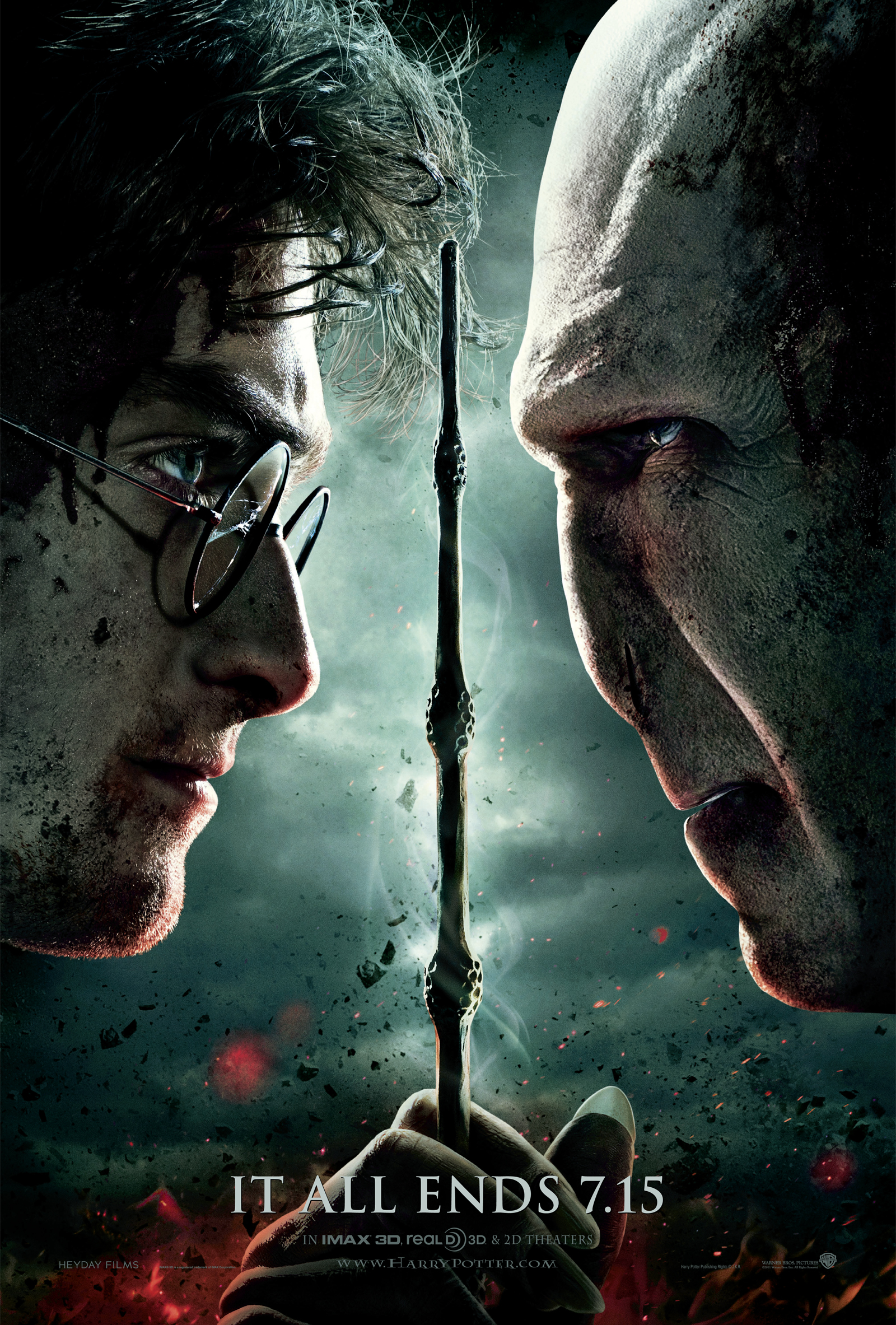
A couple of days ago, the first poster for the last Harry Potter movie was released.  I thought it was awesome in its simplicity.  Harry facing off against Voldemort with only the Wand of Destiny clenched between them.

However, can you think of a more cliched article of fantasy writing than the wand?  What witch, warlock, mage, or sorcerer would not be properly attired without the final touch of this powerful weapon, whether it be a traditional stick of wood or a staff of power...or perhaps even a light saber.

And if you're a writer of fantasy or paranormal, you have probably worked a wand of some sort into your own manuscript.  But as writers, we seek to always bring something new to whatever we create.  And breaking out from old cliched devices is incredibly essential to giving our reader OUR fresh perspective.

JK Rowling does exactly this with her creations, even when they come from traditional lore.  We can learn a lot about putting a fresh spin on an overused device by what she does with her magical wands.

From the very beginning we learn that "the wand chooses the wizard."  Not the other way around.  Wands have their own lore, their own power, their own loyalties, and another's wand will not give you the same results as the one that chose you.  Each wand is unique in its craftsmanship, like the owners they choose, and the wand's maker, like Ollivander, take great pride in their craft and remember every wand sold.

As the series progresses, we see hand-me-down wands, broken wands, brother wands, dueling wands, and spells that tell a lot about wands, such as priori incantatem.  With each of these examples scattered throughout the series, the reader's knowledge of the unique place wands have in this world grows.  Thus, JKR prepares her reader for the final showdown and the most important wand of all.

Since ancient times, sticks of one sort or another have been used as symbols of power and authority over people.  From Pharaoh's was to Moses' rod, to a royal scepter, to the Pope's papal staff -- what person can hold power without brandishing a stick of some sort?  Do we imbue these wands with power because of ancient images of a shepherd's guiding crook, or the disciplinary rod of a father over a child?  Or perhaps they go back even further in our collective memory and hint at a primordial time when the holiest of places, the highest authority, was found in a grove of trees?

Whatever the reason, sticks of wood convey authority and power and JKR used this to her full advantage, with her own twist, in the final book, Deathly Hallows.  The Elder Wand that Harry and Voldemort both seek to claim, the symbol of protection against death, lies in a sacred tomb that Harry refuses to disturb, but Voldemort violates.  It is this attitude that no one matters besides me, contrasted against Harry's self-sacrifice for the love of others, that is ultimately Voldemort's undoing.  No totalitarian authority is allowed to live forever when those oppressed finally are roused to rebel.  Not even the Deathstick, that magical ultimate weapon of mass destruction, can save Voldemort from a simple boy's kindness of heart.  For it is Harry's nonviolent disarming of his classmate Draco which has won the loyalty of the Elder Wand.  And it is his casting of a non-lethal spell into the face of Avada Kedavra, that turns the killing spell back onto its caster, and bring the end to He-Who-Should-Not-Be-Named.

In her intricate plotting, JKR thought deeply of the themes she pursued throughout her series and how these themes would live in the world she created.  Her wands tell us a lot about how the author views the magical world, and our own.  As Dumbledore said, "Voldemort himself created his own worst enemy, just as tyrants everywhere do! Have you any idea how much tyrants fear the people they oppress?" (p. 510, HBP)

Recent events in the MiddleEast have shown what Voldemort learned too late -- even in the real world we witness that how ruthlessly a ruler wields his wand of power is often an indication of how brutally he will be brought down by those who've suffered under him.

Writers -- Look at your symbols, your cliched items of your genre.  What fresh spin can you bring to the tired symbols and tropes?  Think deeply about your story, your world, your hero, and your meaning.  Are your themes reflected throughout?  And if not, what can you do to weave your own Wand of Destiny over your creation and make it truly come alive and sing with your Voice?

Deathly Hallows poster credit
Was scepter image credit

Wednesday, December 29, 2010

That Extra Zing

When studying the phenomenal world-building of JK Rowling, I like to break her craft apart into three sets: The Wide Angle Lens, the Zoom Lens, and That Extra Zing.

In building your set, not only do you want your reader to experience a fully alive, intriguing world in wideness and detail, but you want some of those details to sizzle with extra flavorful zing.

For examples of the Zing, I'd like to share two of my favorite details from JKR's worldbuilding which I think go beyond the ordinary to add an additional, delightful touch.  And better yet, they both happen to come from Christmas!  (Hey! It's still the holidays.  My tree's still up.  The kids are still out of school! :-)

The Hogwarts staff, demonstrating a continued desire to impress the visitors from Beauxbatons and Durmstrang, seemed determined to show the castle at its best this Christmas. When the decorations went up, Harry noticed that they were the most stunning he had yet seen inside the school. Everlasting icicles had been attached to the banisters of the marble staircase; the usual twelve Christmas trees in the Great Hall were bedecked with everything from luminous holly berries to real, hooting, golden owls, and the suits of armor had all been bewitched to sing carols whenever anyone passed them. It was quite something to hear "O Come, All Ye Faithful" sung by an empty helmet that only knew half the words. Several times, Filch the caretaker had to extract Peeves from inside the armor, where he had taken to hiding, filling in the gaps in the songs with lyrics of his own invention, all of which were very rude.
(p. 395, GoF)

Even though this is a lump of description, it’s kept from being boring by the imaginative, unusual detail, and the action within. That last bit, about Peeves filling in rude lyrics, to me is quite witty and adds the extra zing. JKR could easily have stopped with the everlasting icicles, the hooting, golden owls, and the singing suits of armor. That alone would have provided the whimsical Christmas feel she was after. But in taking it that extra level--the Peeves factor--she truly brings the whole setting to magical life...and makes it loads of fun.

One of my favorite descriptions on steroids, which I also listed in my post on favorite tidbits from Harry Potter, was the Christmas tree gnome topping the Weasley tree in HBP.

Stupefied, painted gold, stuffed into a miniature tutu and with small wings glued to its back, it glowered down at them all, the ugliest angel Harry had ever seen, with a large bald head like a potato and rather hairy feet.
(p. 309, HBP Bloomsbury)

Those hairy feet add the zing to an already fully-imaginative description. I would love to be able to come up with something so clever and amusing with so few words.

As writers, we build a world in whatever story we write, even if that world is the contemporary one most readers inhabit.  Your reader still doesn't know YOUR particular setting.  How you choose to describe that world, and what elements you choose to highlight, will greatly affect the feel and perception of your story by the reader.  Make sure that you've thought your world through in complete detail (even if it is not all given on the page).  Then, include these delightful, tasty nougats to help your reader experience your story as a participant and not merely an observer.

A note of caution on zinging -- a little goes a long way.  With ever-decreasing word counts, we have to be very careful to spend words only where important.  Therefore, make sure any extra details you add to your descriptions are truly wonderful AND that they add to your story significantly...preferably in more ways than one!

What nuance can you add to your perfectly good description to give it that extra sparkle? Can you share one you're particularly proud of?


Gnome picture credit.

Thursday, September 2, 2010

Missing Letters to Imagination

Did many of you see a common thread passing around Twitterverse yesterday, September 1?  From agents to HP character impersonators, to Wizard Rockers, to regular fans--loads of people were talking about either catching the Hogwarts Express, or lamenting their missed letters.

Why all this hoopla over a pretend starting day for a fictional school?

Because Hogwarts seems totally awesome to so many people.  And, most importantly, incredibly real.  As one Tweeter put it, Hogwarts is way more fun than his real school.  Who wouldn't want to go there?

Fans love JKR's wizarding world so much that they can't let it go, even though the series is complete.  They must find ways to keep Hogwarts and Hogsmeade, the Burrow and Grimmauld Place alive, playing in its rich imaginary corridors and dungeons constantly.

How real is your world?  How vividly have you imagined your shops and streets, your hospitals and homes?  How strongly have you captured your imagination in black and white on paper or monitor?  Have you put all your effort into giving your reader more than they expect?  Have you provided such richness and authenticity of detail that your fans, too, one day will play in your universe as if it were better than real life?

World building is one of the most important elements that JKR did so right.  It's impossible to cover all her world building techniques in one post, but follow the World Building label below, and I'll keep coming back to it again and again, trying to learn, hoping to unmask her magical secrets.

Because while my Hogwarts letter must have gotten lost in the mail too, :-( , I've got a ticket to an imaginary world of my own creation that thrills me just as well...if not better.

What about you?  Where's your imagination taking you today?

Sunday, August 22, 2010

Maturing the Mandrakes

For an example of the zoom detail (see prior article) which JKR weaves in so delightfully, I thought it would be good to look at a bit of world building which progresses throughout one story.

Remember the mandrakes from Chamber of Secrets?  Those wonderful potted plants which Professor Sprout was nurturing to stew up and give to Harry's classmates who had been petrified?  JKR depicted the mandrakes with such humorous, human detail, which was only depicted in one scene in the movie.  But in the books, bit by bit, she showed the mandrakes growing up. I thought it would be interesting to capture this clever progression in one place.

During the first day of classes:
Harry snapped the earmuffs over his ears. They shut out sound completely. Professor Sprout put the pink, fluffy pair over her own ears, rolled up the sleeves of her robes, grasped one of the tufty plants firmly, and pulled hard.
Harry let out a gasp of surprise that no one could hear. Instead of roots, a small, muddy, and extremely ugly baby popped out of the earth. The leaves were growing right out of his head. He had pale green, mottled skin, and was clearly bawling at the top of his lungs.
(p.117 - 118)

Professor Sprout had made it look extremely easy, but it wasn't. The Mandrakes didn't like coming out of the earth, but didn't seem to want to go back into it either. They squirmed, kicked, flailed their sharp little fists, and gnashed their teeth; Harry spent ten whole minutes trying to squash a particularly fat one into a pot.
(p.119)

~~~~~~~~~~~~~~~~~~~~~~~~~~~~~~~~~~~~~~~~~~~~~~~~~~~~~~ 

Right before the Christmas break:
By next morning, however, the snow that had begun in the night had turned into a blizzard so thick that the last Herbology lesson of the term was canceled: Professor Sprout wanted to fit socks and scarves on the Mandrakes, a tricky operation she would entrust to no one else, now that it was so important for the Mandrakes to grow quickly and revive Mrs. Norris and Colin Creevey.
(p.250 - 251)

~~~~~~~~~~~~~~~~~~~~~~~~~~~~~~~~~~~~~~~~~~~~~~~~~~~~~~

In early February:
There had been no more attacks since those on Justin and Nearly Headless Nick, and Madam Pomfrey was pleased to report that the Mandrakes were becoming moody and secretive, meaning that they were fast leaving childhood.


"The moment their acne clears up, they'll be ready for repotting again," Harry heard her telling Filch kindly one afternoon. "And after that, it won't be long until we're cutting them up and stewing them. You'll have Mrs. Norris back in no time."
(p. 298 - 299)
Note: this is really quite gruesome when you think about it. Professor Sprout is nurturing these baby mandrakes in order to cut and stew them up.

Saturday, July 24, 2010

Zooming in on Your World

In the last post, The Wide-Angle View of World Building, we looked at how JKR used a wide-angle lens to provide the feel of a fully bustling world for her reader. Now let's look closer at the rich texture she provides through a zoom lens.

JKR filled her world with such minute details, and loads of them, that her critics claimed it was over done. But consider her primary market--kids eat this stuff up, quite literally:

• Bertie Bott's Every Flavor Beans
• Drooble's Best Blowing Gum
• Chocolate Frogs
• Cauldron Cakes
• Licorice Wands
• Pepper Imps
• Sugar Quills
• Blood Flavored Lollipops
• Cockroach Clusters
• Fudge Flies
• Butterbeer
• Gillywater
• Ogden’s Old Firewhiskey
• Pumpkin Pasties
• Jelly Slugs
• Acid Pops
• Hagrid’s Treacle Fudge
• Magotty Haggis (served at the Deathday Party)

This is a short list, just to give you the idea of the minute and interesting detail she puts into every ounce of her worldbuilding. Notice not only does she pay attention to the foods that her characters eat, but she made her confections fun and appealing to her age group.  I mean, who couldn't love a cockroach cluster?

Here's another list for a slightly different focus:

• Advanced Potion-Making by Libatius Borage (includes the Draught of Living Death)
• An Appraisal of Magical Education in Europe
• The Beaters' Bible by Brutus Scrimgeour (wonder if he’s related to Rufus Scrimgeour)
• Broken Balls: When Fortunes Turn Foul
• Curses and Counter-curses (Bewitch Your Friends and Befuddle Your Enemies with the Latest Revenges: Hair Loss, Jelly-Legs, Tongue-Tying, and Much, Much More) by Professor Vindictus Viridian
• The Dark Forces: A Guide to Self-Protection by Quentin Trimble
• Death Omens: What To Do When You Know The Worst Is Coming
• The Dream Oracle by Inigo Imago
• Guide to Advanced Transfiguration
• Hairy Snout, Human Heart
• A History of Magic by Bathilda Bagshot
• Hogwarts: A History (a major treasure troves of information)
• Magical Water Plants of the Mediterranean (talks about Gillyweed)
• Magick Most Evile (mentions the Horcrux)
• The Monster Book of Monsters
• Moste Potente Potions (includes the Polyjuice Potion)
• Nature's Nobility: A Wizarding Genealogy
• Olde and Forgotten Bewitchments and Charmes
• Prefects Who Gained Powerhttp://www.blogger.com/post-edit.g?blogID=5330251478298712601&postID=4772635350047624639
• Quintessence: A Quest (a clue to the series' theme)
• The Rise and Fall of the Dark Arts
• Unfogging the Future by Cassandra Vablatsky

What is really cool about this list of books, beyond the fact that I'd like to buy them all, is that most of them are not just throw-away detail, but contain clues toward the series. Indeed, most of her details add something beyond mere description, whether hiding or highlighting a clue, or providing information on the backstory of the characters and setting. Very little of her zoom details are thrown in just as fluff.

The details you will add to your story will vary greatly by genre and target audience. A mystery should be filled with clues or red herrings. A romance will be packed with hints of the developing love between characters, with their backstory packing emotional luggage. A thriller or suspense should have details that hike the tension and darken the feel.  But make each one serve double-duty, not just to lay building blocks for your world, but to also build character, hide clues, highlight themes, and hint at the plot to come.

What fun worldbuilding details have you layered into your world? And what purpose do they serve beyond mere window dressing?

Also Recommended:

See TS Tate's World Building and a Cure for the Block.  She gives excellent examples of how JKR uses sensory details to build her world!

Thursday, July 22, 2010

The Wide-Angle View of World Building

Most readers cite JKR's world-building as the lure that drew them into the Harry Potter series to begin with. JKR riddled the text with so much fabulously imaginative, fun, and complete detail that readers fully believed, for the few hours they were engrossed in the books, that they were indeed living in a world among wizards and witches, goblins and house-elves, giants and ghosts, and basilisks and hippogriffs.

JKR uses many layers to create her world. Her rich details come into focus through both a wide-angle and zoom lens. The reader experiences these angles simultaneously, but in this post, we'll look at the wide.

I find it highly significant that Harry’s introduction to the Wizarding World was not at Hogwarts but at Diagon Alley. Think about it--JKR could have had Harry’s books and supplies provided by the school once he arrived. But she wanted Harry, and the reader, to experience from the start that the Special World Harry was entering was full and complete and only diagonally set apart from our own.

At Diagon Alley, in that first visit with Hagrid, Harry encounters:

  • The Leaky Cauldron, Tom the barman, all the customers who are thrilled to finally meet him ... Doris Crockford several times

  • Gringotts, the wizarding world bank, where he meets goblins and hurtles hundreds of miles below London on a wild amusement park ride, past an underground lake and dragons, to his own vault of gold

  • A snotty rich kid trying on robes at Madam Malkin’s who asks if his parents were “our kind”

  • Flourish and Blotts, the Apothecary, and Eeylops Owl Emporium as he acquires his books, quills, parchment, a cauldron, potion supplies, and a birthday gift from Hagrid--Hedwig

  • Ollivanders, where his wand chooses him and he learns the special connection he has, through his wand’s phoenix core, to He-Who-Must-Not-Be-Named
All of that in one chapter. As the book and the series progress, Harry's Special World, like Perkins’ tent or the trunk of the Ford Anglia, magically enlarges even more. Throughout the series, the reader experiences: Setting -- (Muggle Equivalent) Hogsmeade -- (an entirely magical village)
St. Mungo’s -- (Hospital)
Ministry of Magic -- (Government)
Department of Mysteries -- (Research Facility)
Beauxbatons and Durmstrang -- (Foreign Schools)
Azkaban -- (Prison)
The Burrow -- (the Weasley home)
Grimmauld Place -- (Sirius Black’s home and Order headquarters)
Godric’s Hollow -- (Lily and James’ home village)
Quidditch World Cup -- (The World Soccer Cup)
The Daily Prophet -- (Newspaper)
The Quibbler -- (like the National Enquirer)
Little Hangleton -- (Riddle and Gaunt hometown)
Tom Riddle’s orphanage -- (Riddle’s “home”)
Tom Riddle’s cave -- (Riddle’s hiding place)
Slughorn’s home -- (Muggle dwelling)
Malfoy Manor -- (Rich "gated" mansion)

This list is by no means exhaustive. The reader, and Harry, experience a vibrant world thriving and performing on a daily basis. A world full of people who are going to be affected by Harry’s choices. Some of these people would live or die as a direct result of Harry’s actions.  And if the reader is going to be affected by their fate later on, they need to experience them and their world personally beforehand.

Have you fully realized the world your hero or heroine inhabits? Have you built the bank, the prison, the government, the newspapers, the books, the schools, the playgrounds, the hospitals, the homes, the shops ... even if your reader may not ever go there? A variety of settings not only provides the feel of a fully developed world, but helps prevent the reader from getting bored.

What other wide-angle settings from Harry Potter can you remember?

Be sure to check out JKR's Zoom Angle of Worldbuilding as well.

** Credit to Neville at Sodahead.com for the Diagon Alley picture.